Tuesday, May 29, 2007

Arbutus

There is a danger to reviewing on the cheap, even for bloggers a notorious tight group of souls. This came to mind in considering Arbutus, a spare and clean-lined establishment just south of Soho Square. Planning to eat at Gordon Ramsay, St. Johns, and The Fat Duck does not come cheap, and I was delighted to learn that Arbutus, a well-regarded new restaurant in Soho, emphasizing Haute-Comfort food, was open on Sunday evening, and offered a three course pre-theater menu for 17.50 pounds. As Arbutus had been named the New Restaurant of the Year by Time Out London, the offer was too tempting to pass up, and, if the choices were not what I would have selected without constraint, they matched my tastes quite well.

And, truth be told, these three courses were sufficiently well-prepared that I wondered what I might have been treated to had I placed myself in the hands of Chef Anthony Demetre. Pre-theater menus have two traits that serve them well for diners, but less well for critics. They are designed to be prepared efficiently and are chosen because their food appeals to a wide swath of dinners. So, I was not presented with offal or with those dishes that are awash in the chef’s sweat.

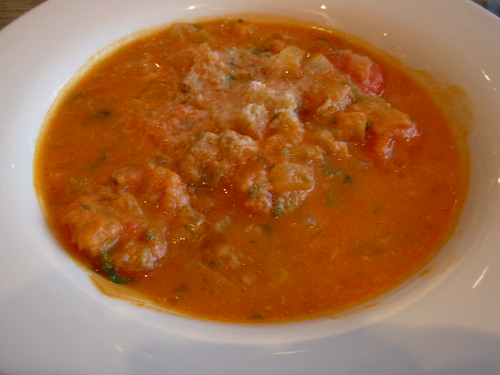
Still, considering the rate of exchange, a dinner for $35.00 (with VAT included; service of 12.5% is added) is a deal. I began with a lovely soup of crushed tomatoes, which was as its name suggests a robust and textured red. The soup was fine served hot, but would have been more luscious if chilled later and served in the late summer tomato heat. This chef is willing to experiment with herbs, and I particularly admired the thin slices of fennel that enhanced the depth of the tomato.

Arbutus - London - Crushed Tomato Soup

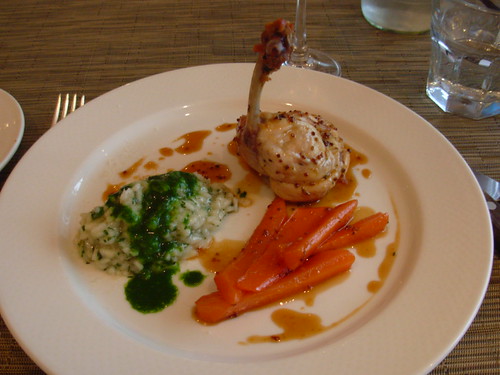
The main course was a simple Rabbit Loin with Mustard Sauce, Herb Risotto, and Baby Carrots. If the artistry didn’t astonish this diner, the mustard sauce was beautifully puckery, and the emerald risotto was powerfully flavored with what must have included half of a herbarium. The dish was not flashy, but well-proportioned and rapidly prepared.

Arbutus - London - Rabbit Loin with Mustard Sauce, Herb Risotto and Baby Carrots

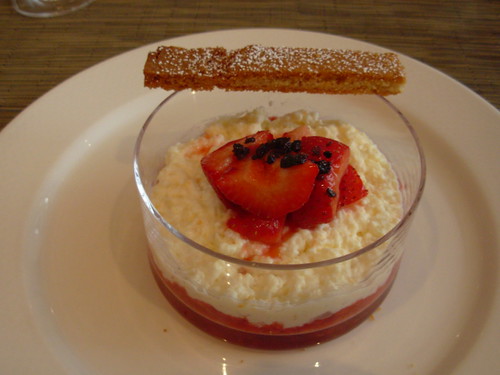
Of the three courses, dessert was the least striking: Rice Pudding Mousse with Strawberry Juice on a bed of fresh Strawberries - appropriate botanically, as Arbutus is refers to the botanical name for the strawberry tree (a tree that once grew in Soho Square). As advertised, here was rice pudding and strawberries. While the pudding was certainly creamy, it seemed more of a pudding than a mousse.

Arbutus - London - Rice Pudding Mousse with Strawberry Juice

As judged from the menu, Arbutus offers more complexity than my pleasant meal provided. Whether Arbutus achieves these goals is a question that I leave for those with deeper pockets.

Arbutus
63-64 Frith Street
London (Soho)
020-7734-4545
www.arbutusrestaurant.co.uk

Sunday, May 27, 2007

The Crown at Whitebrook

It may be needlessly nasty to suggest that being the best restaurant in Wales is rather akin to being the leading intellectual pictured in Maxim or on Entertainment Tonight. If Americans think of Welsh cuisine at all, it is toasted cheese that comes to mind, prepared caerphilly, of course. The Welsh have some fine mountains, fields, and bays, of course – and many fine residents – some of whom prefer to dine in London - but they seem to have a preference for overcooked lamb and boiled leeks.

After two weeks of eating in Cardiff, a friend and I decided to drive through back, wet roads to the Crown at Whitebrook, a restaurant in Monmouthshire – on the English edge of Wales - that has recently received a Michelin star, one of two Welsh restaurants so honored, and the one rated by the Observer as the best restaurant in Wales. Under the direction of Chef James Sommerin, who has headed the kitchen for three years, after serving three years as sous chef, the Crown is the dining destination for those visited the Welsh capital.

The Crown at Whitebrook is not a restaurant of a kind that Americans find often. Hidden in a poetic corner of rustic Britain, it is a lengthy taxi ride from the train and about an hour from central Cardiff. Instead, the restaurant adjoins a rural hotel. The closest model in the United States might be the Inn at Little Washington, some distance outside the District of Columbia. The leading restaurants that dot Napa County have some of the same feel, except Napa operates as a tourist destination.

Guests are invited to arrive half an hour prior to dinner. We were a seated in a pleasantly comfortable hotel lounge, allowed to peruse the menu and wine list, and offered a drink. Such hospitality has its pleasures and drawbacks. The American diner typically arrives ready to go, go, go. Cooling one’s heels is not in our nature. Such slow time has blessings, but makes a long evening longer still.

Unlike urban boites, the décor of the Crown is decidedly muted, notably for creams and beiges and pale greens, set in country moderne. One is not expected to chew the architecture. More important is the graceful service. The servers, congenial and competent, are not the global nighthawks that urbanites have come to take for granted.

My only overarching complaint in what was a carefully composed and luxurious meal it was a de-emphasis of the savory. This was not true of each of the dishes, but many might have been goosed. We began with a set of four canapés. Least successful was a bland, and slightly watery, carrot-coriander soup that lacked strong carrot taste and much indication of coriander. In contrast the snip of fried haddock was a delightful chip of fish, beautifully prepared. Also stirring was a canapé of beet and goat cheese.

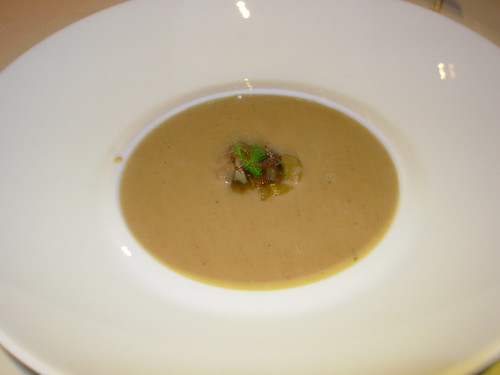
We were both startled and pleased by our amuse: a small bowl of chestnut soup with wild mushrooms and poached quail egg. It was as dense and woodsy as a late fall afternoon, served in mid-May. It certainly revealed the skills of our chef, even if it, too, was notable for a smooth and subtle flavor profile.
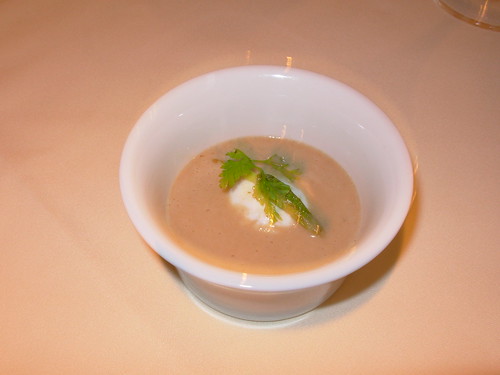
Crown at Whitebrook - Chestnut Soup

As an appetizer, I selected Roast Quail and Quail Confit with foie gras, beetroot, orange marmalade, and caramelized nuts. The dish was luscious and woodsy (again an autumnal dish). As a supporter of chefs who select bitter ingredients, I eagerly awaited the sting of the marmalade, but, again, it could have been used to greater effect. While the dish as prepared was not overly subtle, it could have been still more dramatic.
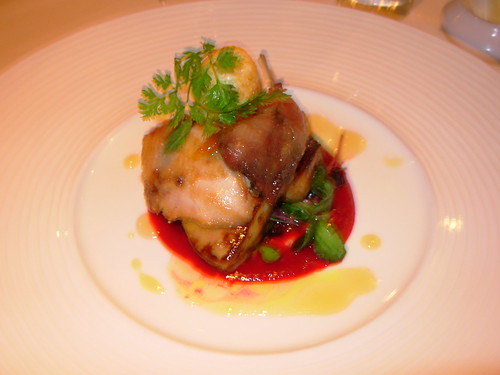
Crown at Whitebrook - Quail

The entree was marinated loin of Welsh lamb with wild garlic, asparagus, lima beans, turnips, fresh morels (the smallest morels that I have (barely) seen, each tinier than a fingertip – little baby morels) with a sauce of licorice and black treacle. With my preferred flavor profile this was a dish that demanded my attention. The dish was complex, congenial, and impressively prepared, but again the licorice and treacle were back-tastes, rather than front and center as would have been more courageous. The idea of the dish was magnificent, the reality just slightly short of brilliant. Unlike the other dishes, this presentation – lamb, morels, asparagus – shouted spring. It was the most seasonal dish from a chef whose cuisine did not seem tied to the climate. My companion, ordering the line-caught seabass on artichoke barigule, sauce d’epice and Parmesan enjoyed the subtlety of the chef’s vision, but wished he had played a more savory hand.

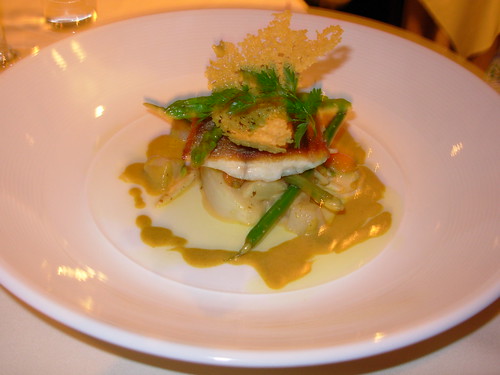
Crown at Whitebrook - Lamb with Morels and Asparagus

Crown at Whitebrook: Seabass

The palate cleaser was a dense raspberry gratine capped with a twenty-first century peach and vanilla foam. Unfortunately the foam was more airy than flavorful, and the raspberry cleansed the palate without foamy aid.

We closed with the recommended Coconut Parfait with Mango Espuna and Chilled Cucumber Soup. Of all the desserts I have recently tasted this was perhaps the oddest. The coconut panna cotta might have used a deeper tropical taste, but the mango provided this edge. The cucumber soup, an elegant and subtle touch, was mostly drowned out by the mango. All this was rather expected. However, the chef, gathering his bravado, added bits of carbonated crystallized sugar, surrounded by cocoa butter – Crackle Crystals as the British call them. Imagine a dessert made with Pop Rocks. It was as if a molecular imp had gained access to the kitchen when no one was guarding the pantry. If this were one of Hester Blumenthal tricks in a 20 course menu, I would have treasured the experience; in rural Wales I was simultaneously amused and puzzled at a moment that made diners April Fools.

Crown at Whitebrook - Coconut Panna Cotta with Mango

Still, the Crown at Whitebrook is a serious dining destination, a kitchen to be reckoned with in London or New York, run by a young chef who is still refining his culinary vision. The food stops short of perfection, because of an unwillingness to commit the drama of taste, even when Chef Sommerin feints to embrace it. If one wishes to be edgy one must accept the danger head on. The Crown will surely deserve its second star at that moment that Chef Sommerin ramps up the licorice and saves his Crackle Crystals for tykes and toddlers.

The Crown at Whitebrook
Whitebrook, Nr Monmouth, Monmouth NP25 4TX United Kingdom
44-(0)1600-860254
http://www.crownatwhitebrook.co.uk
Saturday, May 19, 2007

St. Johns --- Haute Slaughterhouse

There are some restaurants that change the culinary landscape: gastronomic earthquakes. Chez Penisse, Union Square Café, El Bulli and The American Place are some that come to mind. St. John, set near London’s Smithfield Market, is another. Chef Fergus Henderson believes in using the animal from head to end, as he describes in his respected 2004 cookbook The Whole Beast: Nose to Tail Eating. Chef Henderson is fighting a wasting ailment, and will probably never stand behind a stove, but his influence is profound.

St. John eschews the fancy for the solid, the dramatic for the solid. While this style of cuisine has been termed Haute Barnyard, I think of it as Haute Slaughterhouse. It is less the product of the farm than of the butcher. The menu my evening included salted pig’s liver, kid, and chitterlings, but also such rarely served seafood as brill, and pollock. The dining room is ostentatiously simple, more like a nineteenth century workers’ mess, along the lines of Peter Luger. And prices are modest by London standards (my four courses were about 40 pounds).

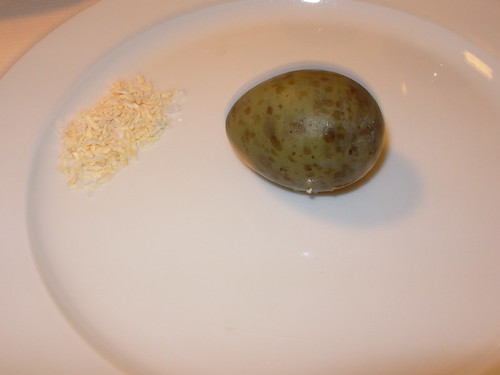
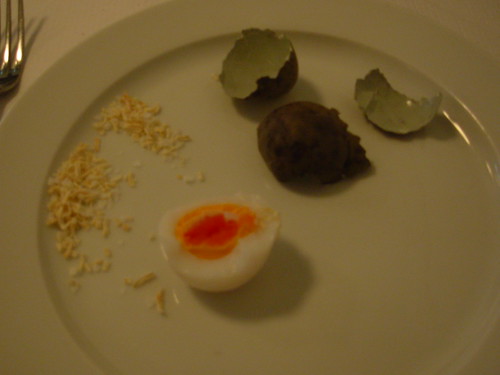
My starter was a single gull’s egg with celery salt. I had some idea that this might be an egg of special flavor, but, despite a spotted shell and startling orange yolk, eaten blindfold this would have the taste much like any hardboiled egg.

Spring 2007 - New York, Wales, London 274

Spring 2007 - New York, Wales, London 275

The appetizer, a signature dish for Chef Henderson was Roasted Bone Marrow – four rough cut bones – with their marrow intact, served with Grilled Toast, Sea Salt, and Parsley Salad with Capers and Onions. This was carnally sublime and the recognition that marrow is moral deservedly helped to catapult St. Johns into the influential establishment that it is. St. John’s food is neither complex or fussy, what makes this work so well is that Henderson takes what has not be considered to be restaurant food, and prove its delights. The addition of the parsley salad matched the marrow, both in its lushness and in that it overturns the belief that parsley is not a suitable focus for high end dining. A remarkable appetizer.

Spring 2007 - New York, Wales, London 276

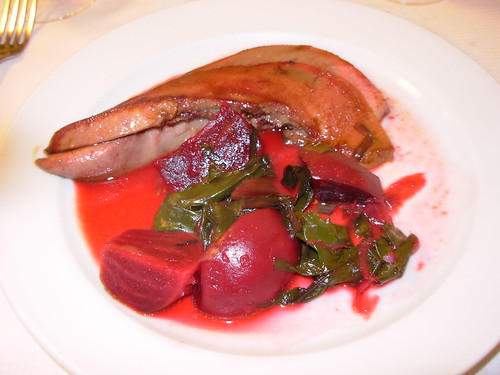
I chose Veal’s Tongue with Beetroot as my main course. The plate was almost audacious in its simplicity. I was presented with two pieces of veal tongue, baked and fried, and some plain beets. Yet, the modesty of the tongue, a most remarkably tender cut with the slightest taste of cured beef tongue, proved that this is no parlor trick. The beet matched the tongue without being elaborated in any way.

Spring 2007 - New York, Wales, London 279

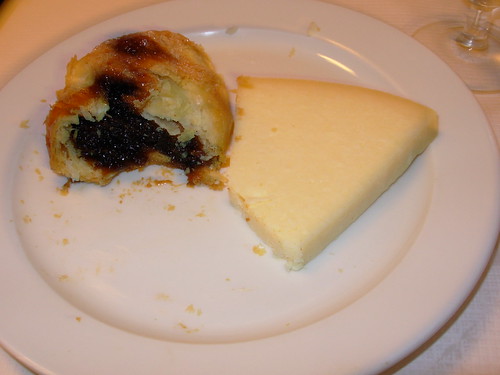
As dessert I selected St. John’s treatment of an Eccles Cake, served with a slice of Lancaster cheese. The cheese was perfectly vibrant, but the Eccles cake, filled with a think and dense layer of raisins, was more of a pastry than a dessert, strictly speaking, and might have been more appealing had it been served warm with a scoop of, say, rum raisin ice cream.

Spring 2007 - New York, Wales, London 281

St. Johns plainspeak is distant from the elegance of Gordon Ramsay where I ate lunch, and yet it is perhaps a measure of the influence of the former on the latter than my lunch included pied au cochon and duck gizzard. While we have not seen a large influence of haute slaughterhouse cuisine on the American shores – and it may take awhile to penetrate, given Yankee squeamishness towards offal – in time we will be consuming veal tongue, unless moral politics intervenes.

St. John
26 St. John Street
London (Smithfield Market)
020-7251-0848
www.stjohnrestaurant.com

Sunday, April 08, 2007

Classic DC Citronelle

Our nation's capital is a town of borrowed bliss. What pleasure that is available originates elsewhere: Rembrandts, cherry blossoms, injera. In culinary terms, do not search for Potomac cuisine, only cuisine on the Potomac.

My recent dinner at the estimable Citronelle illustrated the point. Citronelle is a restaurant easy to admire, hard to adore. It presents an updated classicism, like so much Washington architecture. Michel Richard's Citronelle aims for three-point-five stars, well-satisfied in its deserved achievement. But it is achievement. Still, a tourist wonders whether Chef Richard is still the creative force or whether the kitchen is fully governed by Chef de Cuisine David Deshaies.

When one describes a restaurant as bustling, one often means that customers cram the corners. Citronelle is an establishment in which bustling describes the staff. There are a dizzying and dazzling number of staff charging through the dining room. Each is competent and thoroughly trained (one described lemon as lime, and immediately returned to correct the flub). But Citronelle is one of those restaurants in which the relationship of the dinner and her server is downplayed. Look up and a new face is hovering above. The open dining room - with views of the wine cave and kitchen - was comfortable, although today when architects and designers compete with chefs, Citronelle will not receive attention from Architectural Digest.

I selected the tasting menu (labeled the promenade gourmande) and the well-chosen wine degustation. Considering that several courses were composed of a trio of tastes, this consisted of fourteen courses. Three dishes were magnificent; two were unappealing (both small courses), and the remainder were exactingly prepared, impressive, if not dazzling. What is most notable is that Citronelle doesn't ignored the past, the classic. Perhaps as a result, mesmerizing innovation was a minor component of the tasting menu. The degustation menu felt as if it was not newly minted; the goal was to keep the gustatory machine purring smoothly: both a virtue and a limitation.

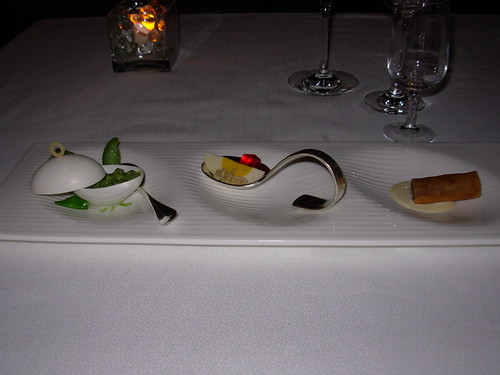
The amusi were three tastes: a barrel of laughs. Least successful was what was labeled the "egg surprise," hopefully not because of the taste. Perched on a sculptural spoon was a wedge of hard-boiled egg, joined with mozzarella, a cube of translucent tomato confit, and crisped rice. While the ingredients seemed eager to please, the amalgam had an off-taste, perhaps from the confit. The idea of the construction bettered the execution. The second entree, a "mushroom cigar" surrounded by a pool of ginger sauce, was a Francophile take on the egg roll. I endorse the two crackly, earthy bites. But the best of the trio - and perhaps the high-point of the meal was a marvelously herbal "haricots verts tartar": a combination of baby green beans and shallots: traditional ingredients with a happy twist. I didn't discover the nature of the dressing, but the dish was simply sublime and sublimely simple. A few classic ingredients, carefully chosen, can reach rapture.

Winter 2007 Photos 218

The tasting menu began with a robust Roasted Chestnut and Peanut Soup. This is not the transparent liquor of modernist cuisine, but a real soup with a rich meaty base. The empty bowl was decorated with foie gras dots surrounding a mound of duck confit. The most distinctive taste was smoky pork, although the chestnut and duck notes were clearly evident. There was less evidence of peanuts than I had expected. It was more meaty than nutty. A soup that might have been a tribute to the Virginia goober country bowed to old Paris.

Winter 2007 Photos 220

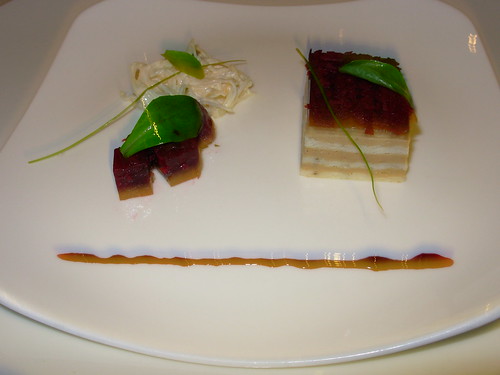
The next dish, as if to mock my Chicago residence, also contained foie gras. This was an elegant Foie Gras-Beet Opera Cake (with a celery root layer) with accompaniments of beet brunois and celery root salad. The dish was more interesting visually than in strictly gustatory terms. The flavors were not sufficiently bright as to make the cake exemplary.

Winter 2007 Photos 221

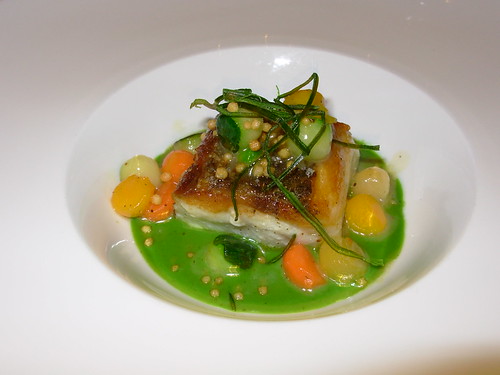
The first seafood dish was the most evocative course of the night: Rockfish with Vegetable Pearls (Rutabaga, Zucchini, and Carrot) and Lemon Verbena Emulsion with Crispy Rice. The perfectly-cooked rockfish benefitted from the verbena emulsion, adding a subtle complexity to the otherwise mild fish, and the rice and pearls added an intriguing, modernist textural contrast. This dish revealed the Chef Richard's debt to classical French cuisine with a light and contemporary sensibility. A triumph.

Winter 2007 Photos 222

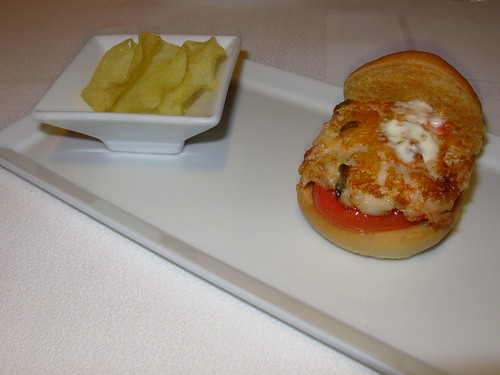
Lobster Burger with homemade potato chips was a conceit. By now such a dish seems routine, and not the most inspired use of a succulent crayfish. This was about all that a lobster burger could be in a fine dining room, but, without sea spray, it never stood a prayer against a perfect Down East lobster roll. A good but wasted course.

Winter 2007 Photos 224

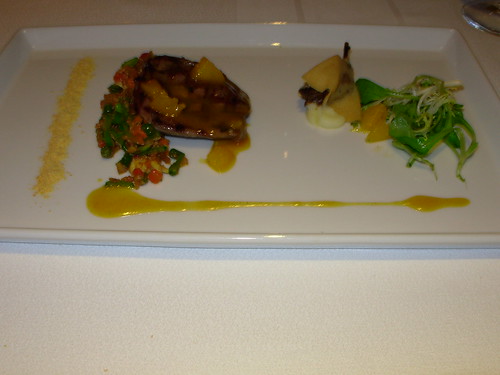
Squab "minute steak" with potato fried rice and citrus-ginger emulsion was another conceit, although more successful in that the comparison with a minute steak was primarily visual. The citrus-ginger sauce - and why not call a sauce a sauce - brought out the slight "gaminess" of the squab without overpowering the quiet poultry taste.

Winter 2007 Photos 225

The cheese course presented four well-selected - and classic - selections: epoisse, blue, rachette, and Camembert, served with pistachio raisin toast.

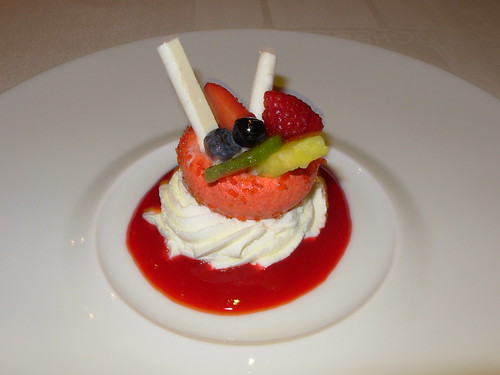
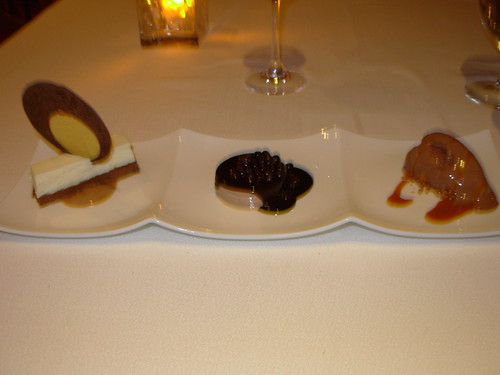
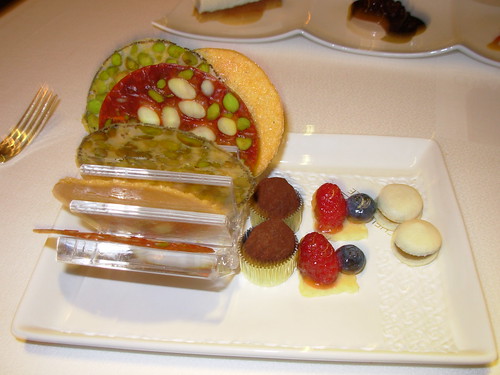
The star dessert followed: Raspberry Vacherin accompanied by raspberry meringue, fresh strawberries and meringue sticks. The photo indicates the craftsmanship of the construction, but the dessert was more than architecture. It was deeply fruity and luscious. This vacherin matched the main courses in its debt to classic cuisine and in its nod to a lightened contemporary taste.

Winter 2007 Photos 227

The final course (not including the petit fours) - Chocolate Three Ways - consisted of a rich and smooth chocolate ice cream, an excellent, evocative and buttery coconut macaroon cake with an elegantly swirling chocolate cookie, and a chocolate panna cotta with coffee topping, with jarring, "off" flavors. (Confession: coffee is not my preferred flavor).

Winter 2007 Photos 228

Winter 2007 Photos 229

Chef David Deshaies is the Chef de Cuisine of Michel Richard's Citronelle, and his talent is not to be denied. Of the foremost American restaurants, few now rely on classic culinary inspiration as much as Citronelle. The finest dishes - notably the monkfish and the vacherin - are contemporary inspirations of the classic. And yet this debt tethers Citronelle to the past, rather than opening the door to an amazing cornucopia of the future. Still, Citronelle reminds us that contemporary cuisine stands on the shoulders of giants.

Citronelle
3000 M Street, NW
Washington, DC (Georgetown)
202-625-2150
http://www.citronelledc.com

Friday, March 23, 2007

Chowder Games - May Street Market

Dining recently at May Street Market, the West Town restaurant, recently celebrating its first anniversary, reminded me of how much I treasure restaurants. Not just the temples - the Trotter, Alinea, Le Francais, or even Frontera Grill - but those two-star templettes, that even when they occasionally stumble, provide so much pleasure at a price that permits middling diners a routine fete. And there are no shortage of these restaurants in Chicagoland, where for well under $100, a diner can indulge as a lesser-sybarite. Consider Avec, Crofton, Lula, Prairie Grass, One Sixty Blue, Spring, Magnolia Grill, Rhapsody, West Town Tavern. The list could go on and on (including Italian and Latin-inflected boîtes). These sterling establishments are hardly interchangeable, but each is serious about food and ambiance, while not performing in the four-star circus.

Within this crew is surely Chef/Owner Alexander Cheswick's May Street Market (always confused with the quite distinct nuevo-Latino May Street Café on Cermak). May Street Market sports a clean, spare space. Some find it cool, others simply cold. As a setting for cuisine it has a white box purity (the bar area is more colorful and is more visually striking). May Street is also known for their affordable wine list (they do not have a corkage fee - either select their wines or choose water). We ordered a splendid 2003 Neil Ellis Stellenbosch Cabernet blend for $38 (about twice the asking price for this South African bottle; not an inappropriate markup).

Service was cheerful, although at our corner table, the busboy and waiter found choreography difficult. We also appreciated the cheer of Chantal Randolph, May Street's Managing Partner, now in Chicago from her home in Zaire.

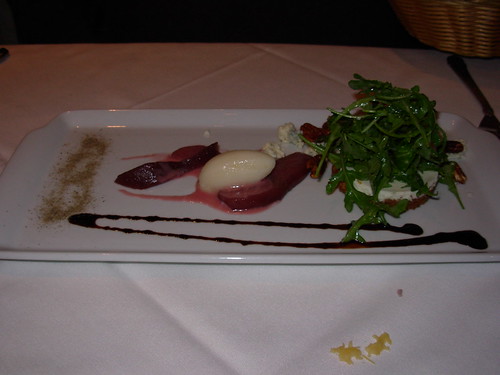
Much of the food was worthy of song, inspirational takes on current trends in cuisine. May Street is known for their Maytag Blue Cheesecake with Red Wine Poached Bosc Pear, Arugula, Spiced Pecans, and Bartlett Pear Sorbet. The savory cheesecake was heavy, and needed to be speared with the poached pear or sorbet. By itself, the cake didn't merit raves, although the plate itself was an elegant mix.

May Street Market Photos 001

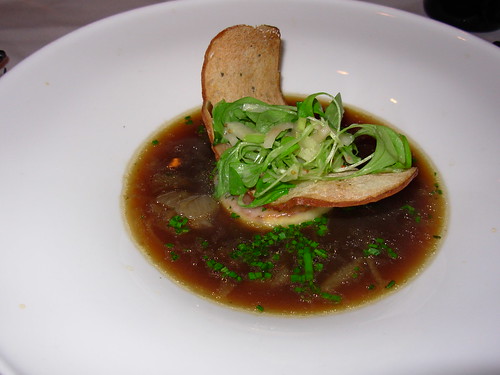
Better - and oh so amusing - was May Street's commentary on molecular cuisine. I thoroughly treasured Cheswick's Deconstructed French Onion Soup with Apple Onion Flan, Mahon Cheese, and a Pretzel Crouton. The soup was sweet and tangy, and lacked the earthy weight that often characterizes Non-deconstructed Soupe l'Oignon. Its cleverness - a twitting of the preposterous outrages of Grant Achatz - in no way marred the favored combination of apple-onion flan, Mahon cheese, and the crouton. Every bite was sublime, including each micro-green. A memorable dish.

May Street Market Photos 002

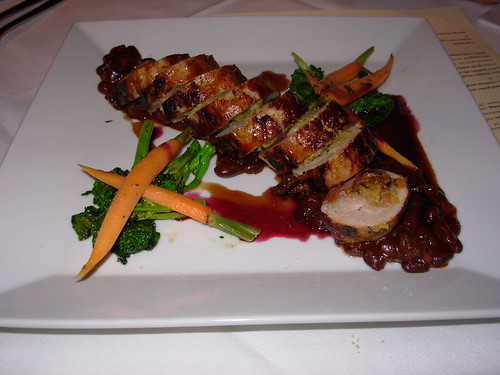
Both main courses were lush and indulgent. Of the two entrees, I give a bare edge to Stuffed Pork Tenderloin with Pancetta and Apricots, served over black beans with mustard grain jus. It was moist, fruity, and dense with pleasure, although, as with all May Street dishes (so common in our dulcet gustatory age), it leaned toward the honeyed.

May Street Market Photos 003

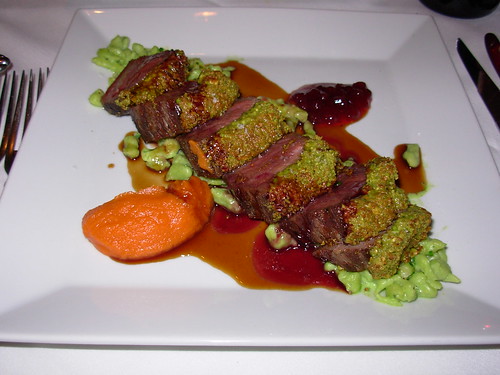
Perfectly Roasted Venison Medallions in a Pistachio Crust with Carrot Purée, Chive Spaetzle, and Lingonberry Sauce was another sterling dish of joyously juicy deer. Still, Chef Cheswick might be reminded that we have four tastes, not merely sweetbuds. This is a cook who offers no bitter love to his diners. The pistachio crust was an instance in which less would have been more. In contrast, the chive spaetzel, appearing as lime-green lima beans, was a delicate surprise. However, the best spot was a perfection of carrot purée. Was there another vegetable for which the word ethereal would have better fit? I suspect not.

May Street Market Photos 004

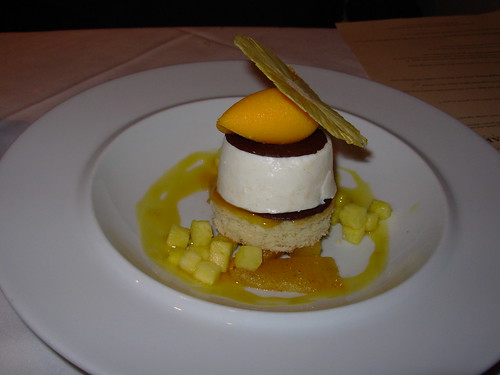
For dessert we shared Coconut Panna Cotta with Vanilla Poached Pineapple, Mango Sorbet, and a Coconut-Coriander Cake. After the splendor of the meats, this dessert faltered. Each element lacked a strong flavor. The cake, absent a powerful memory of coconut or coriander, was dry and plain. The dish appeared lovely, but the love ended at the cornea. The dessert menu reads well, but we lost the gustatory lottery this night.

May Street Market Photos 005

Although May Street Market claims to focus on "regional producers" (and sustainable farming practices), a menu that lists apricot, ginger, pineapple, coconut, mango, lingonberries, sea scallops, truffles, gulf shrimp, calamari, Spanish goat cheese, lemon grass, buffalo, and Dungeness crab has an oddly expansive understanding of region. If we eat global, why not think global? Yes, Maytag Blue Cheese is produced by our friends in Eye-o-Way, but for this early spring menu, a claim that ennobles the local seems a conceit.

Still, May Street Market is a welcome and smart addition to the Chicago dining scene. Perhaps it lacks a distinctive niche, but this takes nothing from its culinary charms. As far as I am concerned, Chef Cheswick can deconstruct my chowder any time he wishes.

May Street Market
1132 West Grand
Chicago (West Town)
312-421-5547
http://www.maystreetmarket.com