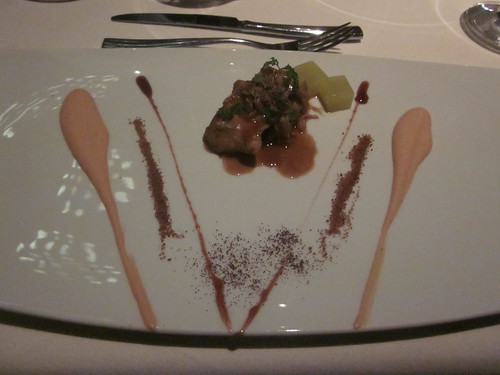
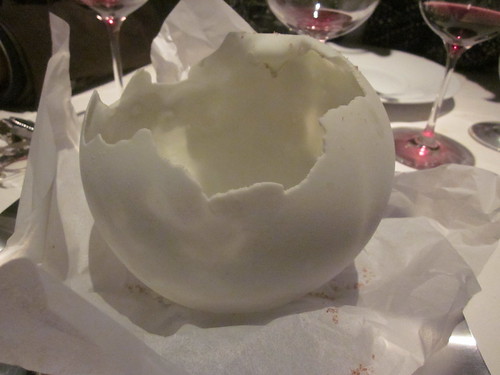
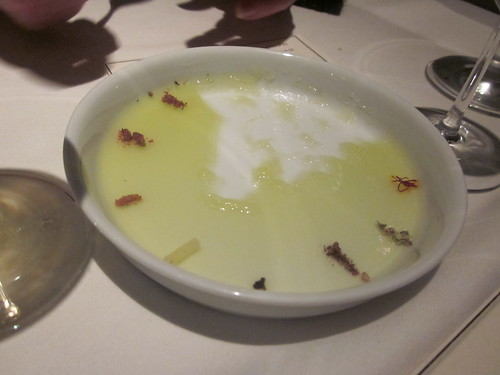
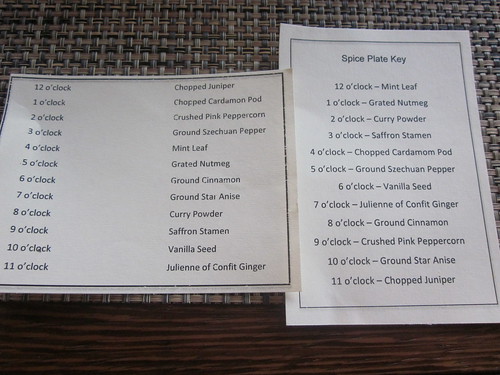
Veal Cheeks

Name: Gary Alan Fine
Location: GLENVIEW, United States

Sunday, May 18, 2008

Vie is for Volume – Vie

There is a thin sounding board – a line in the decibel sand – between excitement and exasperation. Restaurants as organizations appeal to their market niche not just in cuisine and cost, but in clamor and clatter. And the politics of noise can be the undoing – or the doing – of sterling restaurants.

Last Saturday, frightened by the ongoing repairs on the Edens Expressway, feeling cut off from the Chicago dining hub, my wife and I headed west: to Western Springs and Vie, a restaurant that I had once visited on a calm – nearly empty – Tuesday night. Arriving Saturday night at 9:00 p.m. we were escorted into a jangling, buzzy dining space (Vie has a warren of small spaces, not well soundproofed). Despite polished service and Chef Paul Virant’s impressive and confident locavore, seasonal cuisine, what was most memorable about the first half of the meal was the roar of conversation: and this in a restaurant where the tables are not snugly packed and the diners are not screaming sweet nothings. While the core of a review should properly be what is on the plate, it was sound that was on the mind. If Vie hopes to compete with the Chicago luxe restaurants and not to be a glorious bar-and-grill, Chef Virant needs to call his decorator. He gets an earful from this diner.

Given that this review lacks a sound track, I turn to the Chef’s doing. At most restaurants the appetizers are the star: the meal goes downhill from the start. This is not true at Vie: our entrees stole the show. True, my wife ordered a salad (Local Lettuces, Marinated and Shaved Fresh Hearts of Palm, Garlic and Herb Vinaigrette, Parmigiano-Reggiano), and, true, she enjoyed it exceptionally. For me it was a nicely done play on a Caesar-type salad, impressive within the genre.

Vie, Chicago, Lettuce, Marinated and SHaved Fresh Hearts of Palm, Garlic and Herb Vinaigrette, Parmigiano-Reggiano

My appetizer was Wood-Grilled Gunthorp Farm Duck Breast, Cracklings, Arugula, Black Raspberry Aigre-Doux, and Tatsoi (a type of bok choi; Vie helpfully places a glossary on their menu). The combination was very nice indeed, although I found the duck undercooked (mostly a problem of texture). With duck cooked more to my liking, this would have been a superior dish, especially because of the remaining textures and the pungency of the flavors.

Vie, Chicago, Wood-Grilled Duck Breast, Cracklings, Arugula, Black Raspberry Aigre-Doux

As a main course my carnivore partner selected Marinated and Wood-Grilled Painted Hills Strip Steak (provenance is vital at locavore haunts), Baked Wisconsin Cheddar Toast, Local Asparagus, and Creamed Spence Farm Ramps (no other farm will suffice!). As with my appetizer, the meaty center of the meal was enlivened by a set of pungent companions. The dish didn’t need Worcester to have zip and zing. The beef flavor and texture did not dominate but was nicely matched.

Vie, Chicago, Marinated and Wood-Grilled Strip Steak, Baked Wisconsin Cheddar Toast, Asparagus, Farm Ramps

My entrée was splendid. Throughout this mid-May menu Chef Virant teased the diner with seasonal morels in various guises. And I finally gave in to morels, baked crepes, goats milk ricotta (I believe), green garlic vinaigrette, and local Bordeaux spinach. The dish was a triumph. The morels were perfectly tender (and well-cleaned) and the garlic and crepes matched them bite for bite. Chef Virant is as expert a vegetarian as is Chef Trotter (whose vegetarian menu often surpassed his open menu: even with foie gras!). This was the dish that I will treasure: Vie is for Virtuosity.

Vie, Chicago, Morel Crepes, Green Garlic Vinaigrette, Local Bordeaux Spinach

Desserts were both successful. Baba Au Rhum is difficult to destroy, but Vie’s version – Baba Au Whisky, Dooley’s Toffee Liqueur Ice Cream, Candied Walnuts, and Caramel Sauce – is very lush. Without the whisky, it might have been too sweet, but the alcohol keeps the sugar at bay. The warm Caramel Gooey Butter Cake, Almond Chocolate Chip Ice Cream, Almond Lace Cookie, and Almond Toffee Square was also sweetly striking. Although I am not a fan of “gooey” as a gourmet adjective, this cake was gooey. The toffee square was more chewy than I prefer. It was more taffy than toffee, but well-made.

Vie, Chicago, Baba au Whisky, Dooley's Toffee Liqueur Ice Cream

Vie, Chicago, Warm Caramel "Gooey" Butter Cake

Vie consistently turns out impressive cuisine. While not aiming for a pastoral environment, Chef Virant has made Vie into a destination, not only when the Illinois Department of Transportation directs traffic his way.

Vie
4471 Lawn Avenue
Western Spring, IL
708-246-2082
www.vierestaurant.com

[url=http://www.vealcheeks.blogspot.com]Vealcheeks[/url]

Monday, March 17, 2008

Schwa and Frolic - Schwa - Chicago

Six of us visited Schwa last weekend. Typically Schwa limits its tables to parties of four, but on Saturday Michael Carlson called and informed me that because of cancellations, we could expand our table. We embraced his generosity.

I have been to Schwa four times, and have enjoyed my meal each time, but I felt that this evening Chef Carlson was at his most assured and confident and his happiest. There were fewer missteps, and – dare I say it – he looked more relaxed: more ready for beachwear than a hospital gown. This is how a career should be. While the interactions were never unpleasant, tonight there was a joy that had not been evident previously. Fatherhood does that (for awhile) and a few (four) friends.

Chicago boast numerous consummate chefs: kitchen artists who can create stunning meals: Trotter, Nahabedian, Liccioni, Bowles, Achatz, Tramonto, Bayless, Stegner, Joho, Kahan, Cantu. Michael Carlson is among that elite dozen. But his restaurant is not like any other. Unlike David Chang or Jose Andres, he does not pass food across a counter, but cooks and serves and scrapes the pots. I feel myself blessed to visit Naha, Trotters, Frontera every few years, but I want to visit Carlson each season. The fear at its opening was that Schwa was a mirage, a culinary unicorn: it couldn’t exist, and that someday – soon – I might kick myself for not making that last reservation. I kicked last October. Perhaps every chef wants – in fantasy – to do it all, but this is also the hope of the diner. It is nice to be greeted by Chef Trotter, but it is something else to show Chef Carlson that the parsley is misplaced (no parsley tonight!). Schwa is a divine chimera. If I had to choose a last meal in my chill cell, perhaps it wouldn’t be Carlson’s dishes I would first salivate after (except his canonical lusty quail’s egg ravioli), but if I were given a one-night reprieve it would be Schwa that I would visit, and explain to Ashley Dupree that I was engaged. What is remarkable is the creation within that small space on Ashland of a single, momentary community of cooks and diners. I like and admire servers, but let it be me and the stovemen. (I never fantasize about coolly-precise servers, no matter how cute, as long as there are hot cooks about).

I was struck by how carefully Chef Carlson separated and calibrated his flavors and textures. Carlson is less a chemist in the style of Cantu or Achatz than a literary critic: he likes to consider, rearrange, and interpret ingredients as they create a “dish.” His style is not precisely molecular, but it treats a dish as a text to be sliced and diced.

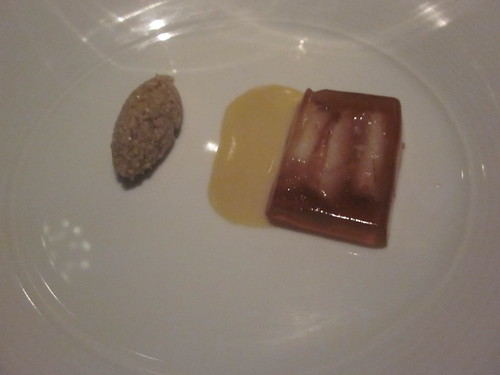
To start at the end. Desserts have been the weak link at Schwa. Pastry chefs have a language that most chefs speak only in pidgin – and the translation between the two accents may be rough as Sam Mason came to realize after receiving pastry encomiums at the sweet genius at wd-50, he was crucified when first opening Tailor in New York. With the small staff at Schwa, desserts seemed – well – half-baked. Not tonight. Dessert was sweetened candied veal sweetbreads with ice wine vinegar caramel, passionfruit culis, lavender foam, and a dehydrated parsnip chip. Although deconstructed dishes often have the disadvantage of being “a little of this, a little of that,” forcing diners to reconstruct the chef’s ideal in their clumsy way, this dish was compelling it its separation, not even considering the literary conceit of the punny sweetbreads.

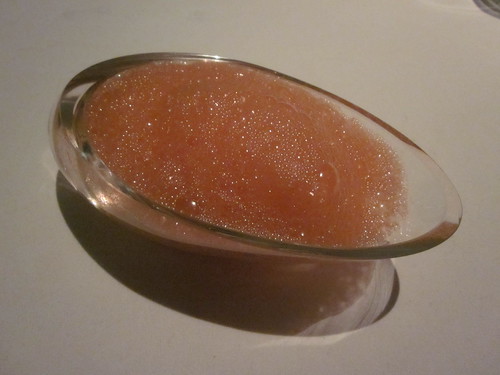
Dinner began with a complex and refreshing amuse of grapefruit vesicles (cells) with honey sorbet, chamomile agar and black truffle shaving. (I credit both “CG” and “wino66” for these borrowed descriptions – the Schwa menu is telegraphic, as is the rage at molecular restaurants: this dish is labeled “amuse”). Here was a lovely combination that was sufficiently robust that the truffle was overpowered. The flavor was dominated by melodious honey sorbet and tart grapefruit. The meal began and ended with the kitchen’s sugary touch.

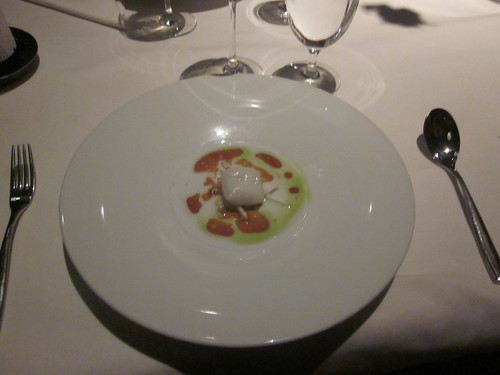
The first course was notable for a brioche that will reside in any bakery hall of fame. We were served pickled Jonah Crab, a slice of dehydrated banana (the dehydrator works overtime at Schwa), batons of celery, celery root and a celery root puree. What was heroic, however, was an unprepossessing cube of brioche injected with hot banana liquor that didn’t just melt but exploded like Carnival. It is a challenge to explain a sensation that is as much tactile and olfactory as gustatory, but it was stunning: doubly mouthwatering.

This appetizer was followed by soup: a potent rich and salty beer cheese soup, made from Chimay washed cheese, served with a freshly made soft “pretzel hole” and a dehydrated mustard chip and an herbal smear. If not as stunning as the previous course, it was intense and intensely satisfying.

Now Chef Carlson returned to a trio of greatest hits. First, Pad Thai: jellyfish with thai flavors. It is a cute conceit and certainly flavorful as a small bite, but it was not a dish that I craved a second time, even though I had enjoyed it previously.

This was quickly followed by the Schwa Pine Cone (I am not certain if I have had precisely this recipe): sea urchin ice cream on a maple syrup flavored cone with some pine essence. The uni ice cream was a lovely palate cleanser, even if the cone was sweeter than necessary and needed a more dramatic pine essence.

Finally the quail egg ravioli. Still fantastic after all of these months. Brilliant. Erotic. Tampopo.

The artic char roe with pumpernickel coins, Meyer lemon puree and rutabaga consommé has been criticized for being out of balance with too strong a pumpernickel presence. Perhaps Chef Carlson has dialed back on this pungency or perhaps I just enjoy marked tastes, but I found the flavors and textures compelling and well-modulated: a remarkable take on caviar-and-blini. This deconstruction revealed true culinary bravado.

Kona Kampachi sashimi with galangal crisp, Lime gelee, maple mousse foam, salsify batons, and daikon disks was wonderful in all ways that a dish can produce wonderment in our firmament. Another deconstruction, this Japanois-inspired, and a very fruitful – reprising the candied mid-March maple-syrup theme of the meal: not too sweet (although the meal was more heavily weighted toward sweetness than some chefs might have dared).

The greatest revelation of the evening was the liver and onions. In a city in which liver has come to mean foie gras undercover: Chef Carlson presented a simple preparation with a disk of calves liver perched on a scoop of onion risotto. What not to like? With liver this sweet and rich, why pine over foie gras? Why duck into liver speakeasies? A dill smear decorated the side of the bowl with small cubes of bayleaf gelee, crispy shallots and pickled cipollini onions. Liver and onions rules!

Our final main course was antelope loin and leg, served sous vide, with butternut squash and white chocolate foam. Perhaps this dish suffered by its placement after the superb kampachi and amazing liver. The antelope was pleasant, the chocolate foam was well prepared, but by this course I wanted a miracle, not pleasure alone.

Our cheese course – once a memorable one-bite pungent (epoisse) cheese risotto, a signature dish of Chef Carlson - was tonight a small wedge of Humboldt fog goat cheese (with a truffled ash layer) and graham cracker crust. It tasted like Humboldt Fog Goat Cheese. Let the kitchen take a breather. And then dessert.

This was not only the most triumphant meal that I have had at Schwa, but the most fun. I revere the Jonah crab appetizer, the Kampachi, the liver and onions, and the Candied Sweetbreads, and, always, the ravioli. But I will mostly prize the experience of being served by a staff that seemed at their ease, having fun, and playing with their food and their admirers. Each hour of joy is a benediction.

Schwa
1466 North Ashland
773-252-1466
www.schwarestaurant.com

Tuesday, January 01, 2008

So Tomorrow --- Blackbird

I enjoyed a splendid lunch at Blackbird. A wonderful way to end a year of eating. The food at Blackbird really flies. At its best Chef Kahan's cuisine is as creative and accomplished as any chef in town, perhaps less elaborated but with a startling and compelling mixture of tastes and textures.

I began with baby octopus confit with braised chestnuts, empire apples, pea tendrils and sassafras caramel. This construction was as fascinating and wildly textured as any appetizer I have had for awhile. Chewy, crackly, smooth and crunchy. Sweet and just a bit sour. A truly magnificent dish.

Blackbird- Chicago - December 2007 - Baby Octopus Confit with Braised Chestnuts, Empire Apples, Pea Tendrils and Sassafras Caramel

As an entree I selected slow roasted duck with fried byrd mill grits, citrus brussel sprouts and puffed wild rice. I was blown away by the finely threaded brussel sprouts - the emotional heart of the dish. The duck, grits and rice, well-cooked, played a supporting role.

Blackbird- Chicago - December 2007 - Slow Roasted Duck with Fried Byrd Mill Grits, Sitrus Brussel Sprouts and Puffed Wild Rice

Dessert was a beautifully composed mission fig beignet with cara cara oranges, butterscotch and bacon ice cream. I have been rather critical of desserts as late, but not this. Like the appetizer, this was one of the most sensational and brilliant desserts of the year. The bacon ice cream seemed simultaneously surprising and totally natural. What a lovely way to end the year.

Blackbird- Chicago - December 2007 - Mission Fig Beignet with Cara Cara Oranges, Butterscotch and Bacon Ice Cream

Why then is Blackbird not often listed in the company with other four star restaurants, where, by virtue of the food it belongs? When Blackbird opened a decade ago it was sleek and chic. But time has taken a toll on the restaurant. The restaurant no longer seems as stylish as it had once been. The plates don't need to be refreshed, but the tables might be. The room is so 1999! The food is so tomorrow!

Blackbird
619 Randolph Street (West Loop)
Chicago
312-715-0708

Monday, December 24, 2007

Purity and Savory *** Washington, DC *** CityZen

Schools must exist in which aspiring chefs are taught to name their culinary domains: Alinea, Per Se, Moto, WD-50, and Washington’s CityZen – a preserve for citizens of a certain level of refinement and resources. CityZen is located in the Mandarin Oriental Hotel in Washington’s new Southwest side. And before we get to the cuisine, the restaurant, although quite pretty is pretty in the way of upscale, contemporary, luxury hotel dining rooms. Serviceable in a post-Millennium sort of way. Speaking of serviceable, service was more than serviceable, it was congenial and helpful.

There has been debate about the level of cuisine at the new venture of Chef Eric Ziebold, formerly at the French Laundry. The food is indebted to Keller with its attention to combinations of flavors and textures, occasionally borrowing from – or contributing to – an experimental cuisine. But how far can Ziebold push his clients? Can Washington ever have truly outstanding cuisine: is that the cost of living in a town in which the prime hunger is for power, not flash, flesh, or fowl? After a recent dinner, choosing the tasting menu, I am among those who rate CityZen highly – except for the bread, more about that later. While my meal was not always astonishing, it was in most regards of the highest order with several remarkable dishes. In comparison to Citronelle, Komi, Kinkead’s, or even Minibar, it is CityZen to which I would first return. Ziebold gives prime of place to simple, simply prepared proteins and surrounds them by zesty combinations.

We began with a pair of amuses, prior to the tasting menu parade. The stronger of the two was a nifty fungal symphony: A toasted mushroom egg puff covered with mushroom powder. This fritter was an earthy, but otherworldly, tribute to late fall. The flavors were deep and the multiple textures clever. It did what an amuse should do, awaken one’s senses to future surprises by the depth of taste.

Washington Food - Toasted Mushroom Fritter Cityzen

The second small plate (is the second amuse still an amuse: when does it become an unadvertised appetizer?) was what I recall as a garlicky mousse-filled gougere situated on a lentil salad. The pastry was as flaky as one could desire, although perhaps slightly salty for my taste.

Washington Food - Gourges with Lentil Salad Cityzen 025

Our first course was as dazzling as a Miró canvas: carpaccio of Atlantic Fluke with Gans Ranch Fuyu Persimmon (even fruit has a provenance), Puffed Japanese Sweet Rice, Micro Peppercress and Pomegranate Vinaigrette. The fluke when cooked properly is a mild and subtle fish, more thrilling for its texture than its taste. Dotting it were the other ingredients, transforming each bite. This is a striking dish, witty and cunning. The taste of the fish ebbed into the background, permitting the vinaigrette a gustatory ovation.

Washington Food - Carpaccio of Atlantic Fluke - Cityzen

Grilled Atlantic day boat scallops with Belgian endive marmalade, citrus velouté, and lobster infused oil was another surprising dish in that, as with the fluke, the scallops, a mild seafood, furnished texture to savory supplements. Although scallops might not seem to be an ideal partner for a sour citrus, the addition of marmalade and lobster oil created a dish that was dreamy, if not dramatic on the plate. It was lush and tangy without being jarring or busy.

Washington Food - Grilled Atalntic Day Boat Scallops - Cityzen

The third plate – Polly-Face Farms Poussin – was similar to the previous two in that it was based on a mild center and savory edges. Authentically produced in western Virginia with Michael Pollan’s blessing (despite the misspelling of Polyface Farms – not only green-card eateries that don’t spell-check), the poussin was paired with dried currant and Italian pistachio mousse with parsnip puree, sugar pie pumpkin and Swiss chard roulle. Simple and pure as the chicken was, the accompaniments made this dish special. The pumpkin and chard roulle was Chef Ziebold’s most memorable presentation of the evening. Again the chef maintains an austere urbane zen-like calm at the center of the plate while circling the center with pungent intensity.

Washington Food - Poussin with Pistachio Mousse Cityzen

The meat course was braised A1 Direct kuroge beef shortribs with marinated beets, cipollini onions and caramelized salsify (I don’t know what A1 Direct might be, but the firm seems uncomfortable like a company that attempts to cadge customers by being listed first in the Yellow Pages). The beef was itself more dramatically flavorful than the chicken, scallop, or fluke. However, the plate became innovative because of the surroundings, passionate beets and sumptuous salsify. Without the accompaniments this would have been a good dish, with them it was robust and flavorful.

Washington Food - Beef Shortribs with Marinated Beets Cityzen

Shortribs were followed by a nicely presented cheese course with some dozen cheeses of varying provenance (A1 Direct?). Since we talking cheese, bread comes to mind. The breads (raisin, bacon, sourdough) from Uptown Bakery were uniformly, uh, awful. CityZen Pain. A four star restaurant should not be serving bread that flirts with stale. I was informed that in 2008 CityZen will be baking their own bread, so clearly they understand their problem. Why an aspiring four-star restaurant would choose to serve bread this pathetic is a mystery. Are there no Ritz Crackers to be had? In fairness, the mini-Parker House rolls, prepared in-house and served with the shortrib, were terrific. They should have been on the table from start to end.

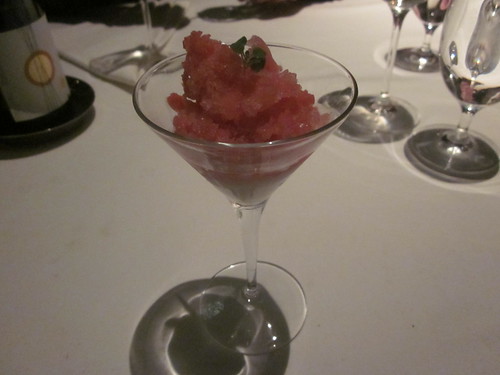
Of the concluding courses, I preferred the palate cleanser, pineapple sorbet with coconut foam and rum gelee. As refreshing as the taste, it was the compelling textures that make this piña colada appealing.

Washington Food - Pineapple Sorbet with Coconut Foam Cityzen

Dessert was cheesecake chiboust (a custard-textured cheesecake) with soft graham cracker and passion fruit sauce, a pleasant change from leaden cheesecakes, and like the earlier course, combined a mild middle with a tart accompanying sauce. However, this passion fruit sauce was not so dramatic as to raise the profile of the dish above the pleasant.

Washington Food - Cheesecake Chiboust Cityzen

CityZen is a distinguished restaurant with a clever chef and clever name. Chef Ziebold has a style that combines a purity of protein with zippy purees, mousses, volutes, oils, vinaigrettes, foams, and marinates. Through his signature style, he forces us to recognize the perfection of central ingredients, even while informing us that there is wild culinary world outside the gates. This is a important message, even if it might permit us to recall the “just” chicken, seafood, or beef and slight the pungent skills of the chef that made it so.

CityZen
Mandarin Oriental Hotel
1330 Maryland Avenue, SW
Washington, DC
202-554-8588
http://www.mandarinoriental.com/hotel/535000039.asp

Friday, December 21, 2007

A Four Letter Word Komi Washington, DC

A fine line separates a culinary signature from a tic. Earlier this month I was in Washington for a week, and at the suggestion of friends I tried Komi, Johnny Monis’s Greek-inflected, slightly rustic, comfortable hot spot. And there is much to like – the service, the collection of well-composed Greek wines (and not a stereotypical Retsina) and the finely-prepared cuisine.

This night my companion and I selected the dinner: a selection of nine mezzathakia, a pasta, an entree, and dessert. We were well-treated. My only complaint was granular. This chef’s four letter word: salt. Sometimes dishes are oversalted out of incompetence: that is not the case at Komi. Chef Monis uses salt to add zest, a taste dimension that often characterizes his dishes. Once or twice during the meal would have been memorable, but the number of dishes that included salt as an ingredient or distinctive flavoring was startling. From the roasted dates with fleur de sel to the oversalted (although perfectly moist) spit roasted katiskaki (goat) to a rather unpleasant Meyer Lemon granita with red sea salt to salty pecan gelato (this I did not order, but there it was on the menu), one could not escape the condiment. Perhaps we should not have been surprised when the farewell gift was a salted caramel lollipop. A chef whose inventions are as distinguished as Chef Monis can find other ways to enliven his plates.

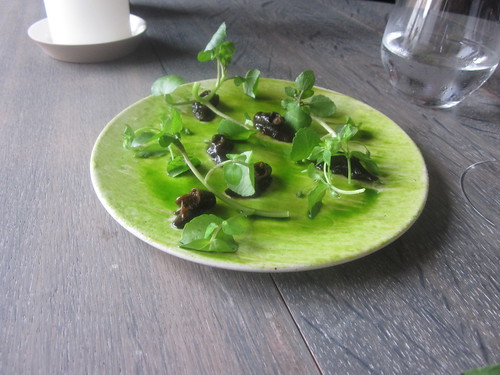
Of the mezzethakia I particularly admired the exquisite, lush cauliflower panna cotta with American caviar, langoustines, and sea urchins. The braised octopus with poached quail egg, capers, pig knuckles (?), and lentil salad was memorable as well. Also successful was a poached lobster salad with bottarga. Both of our pastas were sublime. I particularly admired the tagliatelle with rabbit, snails and eggplant. Here is a chef who knows how to cook al dente. My companion’s rock shrimp risotto with Meyer lemon and sumac-braised pistachio was filled with delicious surprises. Even in my year of dining in New York, I never was treated to such a pair of pastas.

As our main course, we selected the spit-roasted katsikaki – as moist a goat as can be imagined with a delightful crunchy skin. Had the salt been halved this would have been an astonishing dish. The side dishes, pickled plum, Greek oregano, eggplant puree, truffled beet tsatziki, and Habanero hot sauce added complexity to the goat and homemade pita. At first bite the salt added to the pungency of the dish, but soon I wished for pure goat. The sides could have provided the pungency.

Dessert – toasted almond cake with bananas and rum zabaglione was pleasurable – and not at all salty – flavorful but slightly dry for my taste.

I hope to return to Komi on my next visit to Washington with a doctor’s note a demand to lighten our sodium footprint on this fragile planet.

Komi
1509 Seventeenth Street (Dupont Circle)
Washington, DC
202-332-9200

Monday, September 03, 2007

Is Otom a Moto, si? Otom

When a restaurant decides to divide amoeba-style, diners must divine whether the new boîte is a clone, a sib, a spouse, or a bizarro adoptee. What is the relationship between the two? In some cases, Vong or L’Atelier du Robuchon come to mind, restaurants attempt to replicate themselves. In others, such as The French Laundry or Per Se, the genetic code is similar although not identical. In still others - Everest and Ambria, say - the restaurants are distinctive, although similar rules apply through common direction. And then there is Moto/Otom.

How could owner Joseph De Vito, the guiding light behind team Moto, expand? The Moto niche market, while sufficiently enthusiastic, will not appeal to all those nighthawks who fly at twilight through the West Loop. The decision is close to brilliant. De Vito and his chef Daryl Nash (formerly sous chef at Moto) embraced the Moto style, down-marketed it slightly and serves food that tweaks comfort. It is an ingenious strategy, building the Moto brand, while not cannibalizing it (and there is talk about a future dessert bar (a la New York’s Room 4 Dessert: oomt?).

Recently seven faithful members of the LTH board (led by Happy Stomach) paid a visit to Otom to sample much of their menu. The evening was a notable success, even if Chef Nash still must figure out precisely how distinctive and disorienting he wishes his plates to be. Several of the dishes were excellent and proficient (particularly the main course meats), some were good but lacked the stuff of memory, and a few were disappointments. In general, those dishes that worked best were those that incorporated dollops of savory creativity. Otom is still in its three-month shake-down cruise and if the best dishes currently available are coupled with new creations, Otom will be very fine indeed. The spatial layout of the room was somewhat unusual. Our table (perhaps located where it was because of our visit) was at the front of the long room with the middle given over to the bar area and then at the back were placed most of the tables. Possibly were we not present the large front of Otom would be used for the bar crowd. From the list of cocktails, it seemed that the cocktails had much of the creativity of Moto.

Before describing the dishes, the bread at Otom is notable. (Moto does not serve bread, but at Otom we are in the world of happy carbs). The best of the three breads was the slightly sweet pumpernickel, which, when slathered with honey butter was divine.

The service for our group was a combination of French and Russian service. Six courses (two appetizer courses, two main courses, and two desserts) were served with several plates in each course.

The first set of appetizers were a trio of salads: 1) House-smoked turkey cobb salad with bibb lettuce, crispy Pancetta, blue cheese, hard-cooked egg, avocado and grain mustard vinaigrette (no photo), 2) wilted spinach salad with golden beets, smoked oyster mushrooms, red pepper and roasted garlic vinaigrette, and 3) marinated bean salad with red onion, oregano, rice noodles, and caramelized shallot vinaigrette. These salads are ordered in their distinctiveness and in their culinary interest. The cobb salad was a creditable rendition, but with little special appeal. I liked the inclusion of beets and mushrooms in the wilted spinach salad. Perhaps the beets and oyster mushrooms or peppers could have been more dominant, but it was an impressive creation. Most memorable was the bean salad which traded on the crispy rice noodles and oregano. Of the six appetizers, this bean salad was the one that I long to taste again, as much because of the creative texture as a dramatic taste profile.

August 2007 - Otom, Xni-Pec, Schwa 003
August 2007 - Otom, Xni-Pec, Schwa 002

The salads were followed by a trio of more substantial appetizers, 1) beer-battered vegetables with caramelized onions and sherry vinegar aioli (no photo), 2) a set of miniature burgers with bacon and cheddar, mushroom and Swiss cheese, and with a fried quail egg, served with an order of shoestring potatoes, and 3) Chinook salmon ceviche with lime, chili, cucumber and wonton chips. I admired both the vinegar aioli and the creditably crispy shoestring potatoes, but neither the heavily battered vegetables nor the thin, runty, and somewhat overdone sliders were particularly memorable. Although the wonton chips were not wanton in my recall, I admired the firm cubes of salmon in their distinctive marinate. The ceviche could have been served with a thinner cracker that would have brought out the luxurious and bracing taste of chill raw fish.

August 2007 - Otom, Xni-Pec, Schwa 004
August 2007 - Otom, Xni-Pec, Schwa 005

Chef Nash was on stronger ground with his meat dishes: these revealed his abilities to transform comfort food into memories, and were the cuisine for which Otom should strive: not Moto upendings of expectations, but energetic challenges to the tried and true. Our first quartet consisted of: 1) macaroni and cheese with creamy rosemary-white cheddar sauce, smoked carrots, and parmesan-panko crust (no photo), 2) roasted acorn squash and oyster mushrooms with seared tofu and crispy shallots, 3) braised beef pot pie with roasted root vegetables, veal demi-glace and puff pastry, and 4) house-smoked apricot and chili glazed pork back ribs with crisp sherry slaw and pickles. The pork ribs were a real triumph, as Chef Nash transformed a rather traditional dish to one with special resonance. Perhaps the slaw could have used more sherry, but the dish was heroic. The pot pie was an admirable rendition of the classic comfort food. Perhaps it might have incorporated a few twists and turns, but it was nicely prepared. The squash and tofu was deserving of praise, but it is difficult to treat tofu as the sensory center of a plate. Tofu does not – for me – lend itself to memory. The mac ‘n’ cheese was fine, but less evocative than the description. The sauce could have used a few more jolts of rosemary to deserve a poetic account.

August 2007 - Otom, Xni-Pec, Schwa 006
August 2007 - Otom, Xni-Pec, Schwa 007
August 2007 - Otom, Xni-Pec, Schwa 008

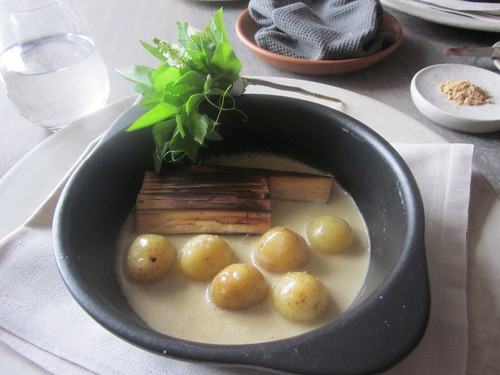
The second quartet included: 1) grilled top sirloin with butter-poached new potatoes, golden onion rings, and veal reduction, 2) grilled swordfish and jicama-Anaheim relish with gooseberry soup, 3) beef short rib ravioli with shallot and sage goat cheese, candied sweet potato and brown butter, and 4) raised lamb shank, white bean cassoulet, rutabaga, and olive oil. The weakest dish of the night was surely the overcooked fish. But the trouble went beyond the cooking; often the dishes on the menu read better than they taste – the promised snappy and distinctive accompaniments, such as the gooseberry soup, are more muted than one might imagine. What promises to make a dish stand out is no more than a back taste; the soup could have had more zing. I encourage Chef Nash to be less afraid of the power of taste, less subtle in his cuisine. In contrast to the fish, the short rib ravioli was the strongest dish of the night. Here the goat cheese, beef, and sweet potato blended in symphonic fashion. It was a superb dish. The lamb shank was also a fine dish, well worth ordering, although perhaps a more generous drizzle of olive oil would have made the dish stand out further.

August 2007 - Otom, Xni-Pec, Schwa 013
August 2007 - Otom, Xni-Pec, Schwa 010
August 2007 - Otom, Xni-Pec, Schwa 012
August 2007 - Otom, Xni-Pec, Schwa 011

I have recently had a problem with desserts. Many pastries cannot meet the standards of the rest of the meal, just as many restaurants (although not Otom) find it hard to insure that the main courses equal the appetizers. We were served 1) apple crisp, topped with house-made vanilla ice cream, 2) strawberry shortcake with crème fraiche and mint syrup (no photo), 3) banana split pops with caramel, roast pineapple, and maraschino cherry, and 4) homemade brownie with home made marshmallow. Of this quartet, the brownie, although simple, stood out, mostly through the virtues of the honest, rough-cut marshmallows. The shortcake was rather dense for my taste, and the apple crisp was too salty. The suckers were easy to love, although not particularly complex in their creation.

August 2007 - Otom, Xni-Pec, Schwa 016
August 2007 - Otom, Xni-Pec, Schwa 014
August 2007 - Otom, Xni-Pec, Schwa 015


From the accounts of the restaurant, it is not certain how much input Chef Cantu has in its vision and its cuisine. Still, Otom stands on its own. It is a restaurant in process: a restaurant that needs to decide the extent to which its cuisine is designed to jolt the diner or blanket her in nostalgic comfort. For Otom to become a destination restaurant for its cuisine the former must be emphasized as with the bean salad and short rib ravioli, and this does appear to be the goal. Otherwise, Otom is in danger of serving 1970 food in a 2010 space.

Not all of the photos are up to standard, sorry.

Otom
951 W. Fulton Market
Chicago (West Loop)
312-491-5804
http://www.otomrestaurant.com/

Friday, June 29, 2007

Oud Sluis - Sluis, The Netherlands

Having friends in high places can challenge restaurant criticism. I recently was invited to spend three minutes asking a question at a Ph.D. oral in Utrecht for which my transportation, hotel, and most meals were paid, plus an honorarium that paid me several Euros for each second of talk. Me and Ms. Hilton, what scammers. With this kind of largess, I decided to blow my pay packet on dinner at Oud Sluis, one of a Dutch trio of Michelin three star restaurants, and the establishment that under the leadership of chef Sergio Herman is making the greatest impact on global dining. I planned my trip carefully, wishing on the one hand to indulge and on the other to be a just and tough-minded critic. But a friend with tasty connection with Chef Herman arranged a special dinner, a plot that I only discovered on my arrival. My evening was an extension and intensification of what other diners might experience.

Oud Sluis is a treasure, much in the culinary style of Per Se/French Laundry, a restaurant that is much aware of the latest trends in molecular cuisine, but, unlike The Fat Duck or Alinea or El Bulli, does not fetishize the odd and abnormal, but uses those techniques along with more classical preparations. Herman is a chef who wishes to explore the savory but without permitting strong flavors to brutalize subtle flavors. He embraces the complex and the whimsical in ways that often succeed gloriously. If there is a caution, it is that Chef Herman is still in process of developing a uniquely personal style and a singular astonishing signature dish, although the entire menu and several presentation reveal considerable culinary facility. After three weeks I can still recall vividly some of Herman's creations, always an important sign. Chef Herman is young and some of the thematic linkages of the meal may have been lost in the generous blizzard of courses I was gifted. But my meal was superior to recent meals at Le Bernardin and Alain Ducasse in New York and the equal of those at Gordon Ramsay and Joel Robuchon.

Perhaps it was due to my connections that service was impeccable, although as best I could tell those diners sitting near me were happily and efficiently chowing down. The restaurant, comfortable, modern, and spare, with an emphasis on light woods and black trim, was attractive in itself, although not so architecturally fluent that one would visit for the decor.

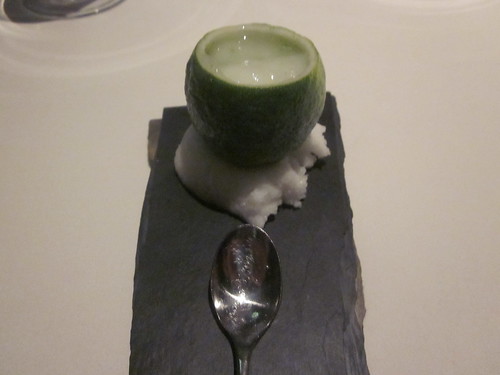
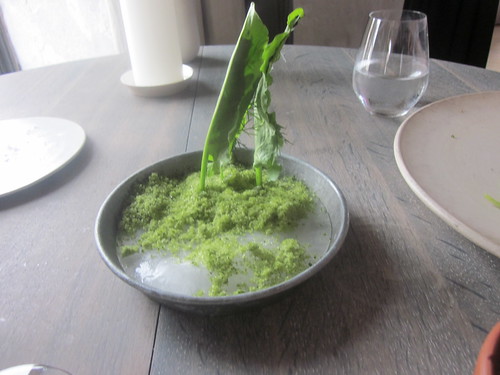
The adventure began with a startling starter. Since these dishes were "off the menu," my descriptions may be less adequate than acceptable on a website of record. The first offering was buckwheat spaghetti with mackerel, marinated in lime and pepper, served beneath an orb of wasabi-sake ice. This aperitif glass was platonic, wakening one's taste buds while revealing the chef's philosophy: a willingness to play with strong tastes (mackerel, lime, wasabi, buckwheat), while moderating them in practice. Despite what might have been a set of clashing tastes and textures, the melding was pure joy.

Oud Sluis June 2007 Lime Sake Wasabi Ice, Buckwheat Spaghetti

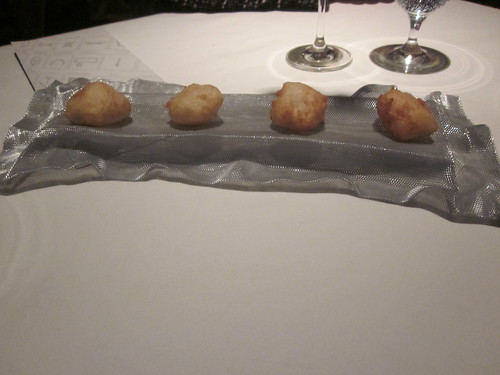
My second opener was a simple cup of aioli with thin crostini. The crostinis of fragile sourdough crust were extravagantly crackly. The garlicky aioli was mixed as an airy cloud. As with the mackerel, this dish played with the strong taste of garlic, but lightened its texture and flavor.

Oud Sluis June 2007 Aioli and Sourdough Bread

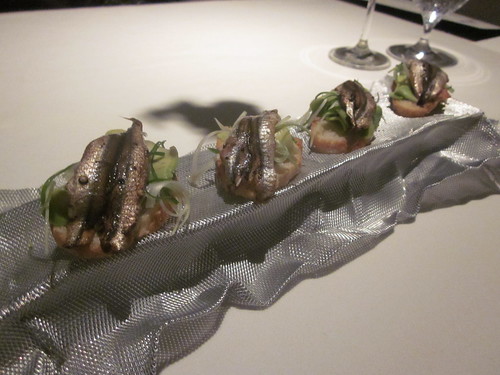
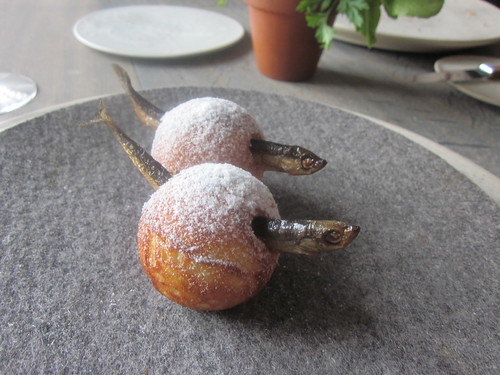
Just over the Dutch border, Chef Herman next teased national expectations, producing a Brussel Waffle. This small pleasure was marinated herring tucked inside a mini-waffle, decorated with dots of curry and avocado cream. The theme of the meal becomes ever clearer: herring and curry, but moderated with cream and wheat. Smooth and rough. This four-bite starter was quite lovely, each bite, both those curried and those floral and nutty green.

Oud Sluis June 2007 Brussel Waffle with Marinated Herring Filling, Curry and Avocado Cream

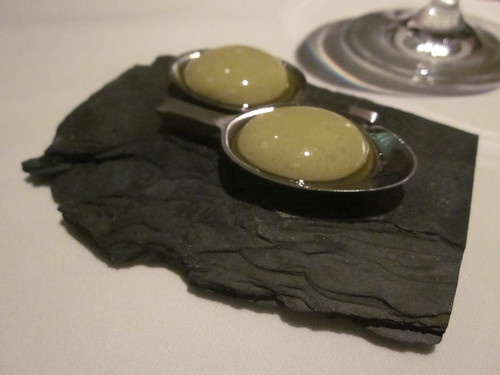
The fourth offering was a Tiffany gem: a gustatory bon bon infused with a puree of Granny Smith apple and a liquid foie gras. The presentation literally bursted with aqueous flavor. This jewel was among the most impressive construction that I have eaten, a surprise that was beautiful to espy, startling to consume, and evocative in memory: rich liver and tart apple, held together by some enlightened gelatin that did not feel or taste like tired and rubbery aspic.

Oud Sluis June 2007 Granny Smith/Foie Gras Bon Bon

This was followed by a double tribute to Chefs Keller and Adria: nitrogenated emulsion of "oyster caviar." It lacked the lushness of Keller's "Oysters and Pearls," but the flinty pearls were more mature than, say, "Caesar Salad Dipping Dots." If one must have such frozen treats, oyster pearls made a lively and amusing choice.

Oud Sluis June 2007 Nitrogenated Oyster Caviar

Next I was presented with a salad tasting: 1) marinated salmon, champagne, dill and asparagus, 2) a salad of potatoes and shallots, 3) A marinated cucumber salad of lobster and radicchio on cracker, and 4) ratatouille with a espuma of escoviche (a Jamaican snapper). Although I found the potato salad less compelling, the other three were excellent. This is a chef who uses foam carefully, adding an edge of fish to his vegetables. The marinated salmon was a lovely take on lox in a modern style. Of the quartet it was the lobster that captured through its luxury - a postage stamp salad that could be sent anywhere.

Oud Sluis June 2007 Quartet of appetizers

Finally the menu, as printed, began. First, Tomato Structures with Marinated Gamba, Basil, Sorbet of Cabernet-Sauvignon Vinegar and Olive Oil Powder. I love fresh tomatoes, but I adored the single cherry tomato that was infused with oil and vinegar: the single best tomato on earth. The remaining four structures, although otherwise notable, didn't stand a chance. They were bystanders.

Oud Sluis June 2007 Tomato Structures

The next dish was my star of the evening, a tartare of langoustine with an emulsion of olive oil and yuzu, with caviar, seafood jelly, and cream of sea vegetables. This rather complex dish (and like Tom Keller, Sergio Herman is partial to complexity - except the above-mentioned cherry tomato) was a brave medley of tastes and textures. The fruity, herbal, salty, and buttery notes were symphonic. Even though complex, the dish had an astonishing lightness of being. Herman's strong tastes did not overpower.

Oud Sluis June 2007 Tartare of Langoustine with Olive Oil and Yuzu Emulsion

This was quickly followed with a foamy turbot: turbot with verbena and "barigoul (artichoke farci) foam" with pan-fried langoustine and tempura of verbena. This was another complex langoustine dish that tamed the savory to good effect. Perhaps the turbot is not as joyous a fish as some, but this was an astonishing and beautiful plate that successful melded fish and crustacean.

Oud Sluis June 2007 Turbot with Verbena and Barigoul Foam

In short order we moved from langoustines to lobster: "Bomba rice" paella with Zealand lobster, chorizo and slowly cooked squid with a sauce of crustaceans and cremolata of peas. Another ravishing and complex dish. Yet, this was the dish that I found disappointing. In comparing this deconstruction to a more traditional paella, my strong preference was for the latter. This was a stripped-down, constricted paella. When deconstructing tradition - "paella" - a chef needs to insure that the quotation marks add value. One can hardly complain about perfectly prepared lobster, but the dish felt cramped and theoretical; it lacked integrity as a tribute.

Oud Sluis June 2007 Bomba Rice Paella with Zealand Lobster, Chroizo, Squid, Suace of Crustacians and Cremolata

The palate cleanser was cucumber three-way: jellied, foamy, and marinated, served as a cocktail. Cucumber when prepared right is God's treat of summer: the refreshment of Eden. This break was glorious.

Oud Sluis June 2007 Cucumber Cocktail

The single meat course was lamb "Sisteron" with courgette (zucchini) flowers, lamb sauce, Parmesan jelly and "poudre d'or." Granted the gold powder was a conceit of a culture with too much disposable income, but the lamb was ideally cooked - juicy and moist, fully lamby - but with a startlingly crispy crust that must have taken some thoughtful effort to achieve. The strip of cheese preserves was good fun. If not the most compelling dish of the night, it was a straight-forward center-piece with memorable twists and turns.

Oud Sluis June 2007 Lamb Sisteron with Courgette Floweers, Parmesan Jelly

This brings a diner to a trio of dessert courses with their own variants: structures of chocolate and caramel with ice cream from salted peanuts; almond biscuit with strawberries and ice cream of elderberry flower; and preparations of raspberry and coconut. At some restaurants desserts are an afterthought, but desserts at Oud Sluis contain the same attempt to tame the savory, and they largely work. I particularly admired the chocolate cream with passion fruit. The fruit was ripe and robust and the elderberry sorbet was well made. Viewing the photographs reveals a pastry chef who works in the same register as the chef: tart complexity, shaped and channeled by an insistence on subtlety.

Oud Sluis June 2007 Structures of Chocolate and Caramel
Oud Sluis June 2007 Almond Biscuit with Strawberries and Elderberry Flower Ice Cream
Oud Sluis June 2007 Raspberry and Coconut Preparations

Oud Sluis deserves the praise it has received. And with a young chef who is still developing his own culinary style, it is likely to improve, although no fourth Michelin star will be in the offing. Oud Sluis may lack the explosive flash and gunpowder of the Fat Duck or Alinea, but it reveals a culinary mind. Today every ambitious young chef is a student of Thomas Keller, but some students are more attentive than others. If Sergio Herman is not a teacher's pet, he is a diner's pet.

At high-end restaurants no meal is truly typical, but thanks to an expansive chef my meal was less typical than some, thanks to the soft kindnesses of my network. Yet, the vision and care of Oud Sluis is sure to be evident for every diner, even those not so well connected as this diner-in-full.

Restaurant Oud Sluis
Beestenmarkt 2
Sluis THE NETHERLANDS
(0031) 0117 46 12 69
http://www.oudsluis.nl