Saturday, May 19, 2007

St. Johns --- Haute Slaughterhouse

There are some restaurants that change the culinary landscape: gastronomic earthquakes. Chez Penisse, Union Square Café, El Bulli and The American Place are some that come to mind. St. John, set near London’s Smithfield Market, is another. Chef Fergus Henderson believes in using the animal from head to end, as he describes in his respected 2004 cookbook The Whole Beast: Nose to Tail Eating. Chef Henderson is fighting a wasting ailment, and will probably never stand behind a stove, but his influence is profound.

St. John eschews the fancy for the solid, the dramatic for the solid. While this style of cuisine has been termed Haute Barnyard, I think of it as Haute Slaughterhouse. It is less the product of the farm than of the butcher. The menu my evening included salted pig’s liver, kid, and chitterlings, but also such rarely served seafood as brill, and pollock. The dining room is ostentatiously simple, more like a nineteenth century workers’ mess, along the lines of Peter Luger. And prices are modest by London standards (my four courses were about 40 pounds).

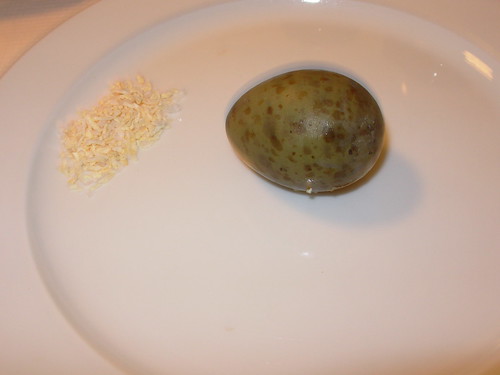
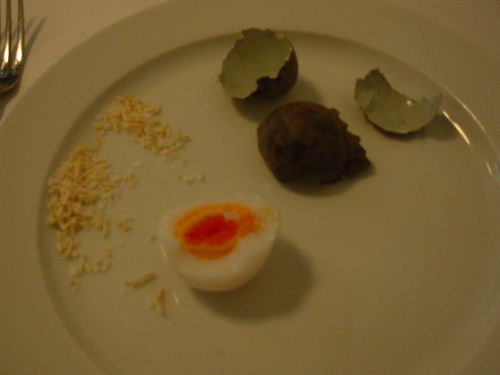
My starter was a single gull’s egg with celery salt. I had some idea that this might be an egg of special flavor, but, despite a spotted shell and startling orange yolk, eaten blindfold this would have the taste much like any hardboiled egg.

Spring 2007 - New York, Wales, London 274

Spring 2007 - New York, Wales, London 275

The appetizer, a signature dish for Chef Henderson was Roasted Bone Marrow – four rough cut bones – with their marrow intact, served with Grilled Toast, Sea Salt, and Parsley Salad with Capers and Onions. This was carnally sublime and the recognition that marrow is moral deservedly helped to catapult St. Johns into the influential establishment that it is. St. John’s food is neither complex or fussy, what makes this work so well is that Henderson takes what has not be considered to be restaurant food, and prove its delights. The addition of the parsley salad matched the marrow, both in its lushness and in that it overturns the belief that parsley is not a suitable focus for high end dining. A remarkable appetizer.

Spring 2007 - New York, Wales, London 276

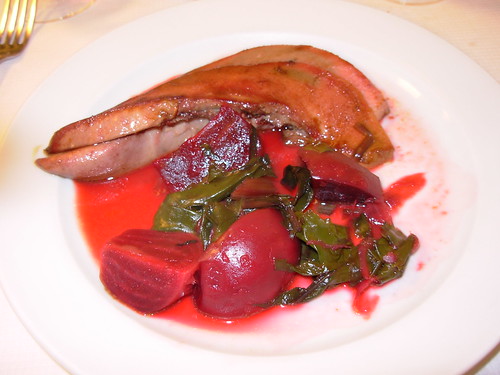
I chose Veal’s Tongue with Beetroot as my main course. The plate was almost audacious in its simplicity. I was presented with two pieces of veal tongue, baked and fried, and some plain beets. Yet, the modesty of the tongue, a most remarkably tender cut with the slightest taste of cured beef tongue, proved that this is no parlor trick. The beet matched the tongue without being elaborated in any way.

Spring 2007 - New York, Wales, London 279

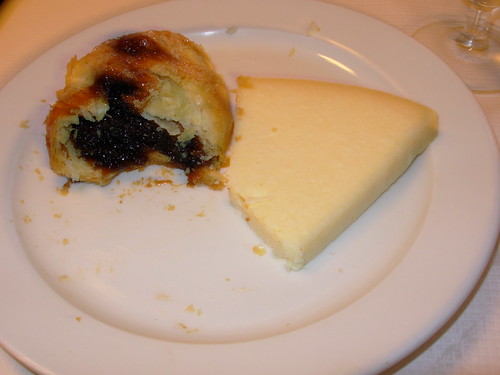
As dessert I selected St. John’s treatment of an Eccles Cake, served with a slice of Lancaster cheese. The cheese was perfectly vibrant, but the Eccles cake, filled with a think and dense layer of raisins, was more of a pastry than a dessert, strictly speaking, and might have been more appealing had it been served warm with a scoop of, say, rum raisin ice cream.

Spring 2007 - New York, Wales, London 281

St. Johns plainspeak is distant from the elegance of Gordon Ramsay where I ate lunch, and yet it is perhaps a measure of the influence of the former on the latter than my lunch included pied au cochon and duck gizzard. While we have not seen a large influence of haute slaughterhouse cuisine on the American shores – and it may take awhile to penetrate, given Yankee squeamishness towards offal – in time we will be consuming veal tongue, unless moral politics intervenes.

St. John
26 St. John Street
London (Smithfield Market)
020-7251-0848
www.stjohnrestaurant.com

Sunday, April 08, 2007

Classic DC Citronelle

Our nation's capital is a town of borrowed bliss. What pleasure that is available originates elsewhere: Rembrandts, cherry blossoms, injera. In culinary terms, do not search for Potomac cuisine, only cuisine on the Potomac.

My recent dinner at the estimable Citronelle illustrated the point. Citronelle is a restaurant easy to admire, hard to adore. It presents an updated classicism, like so much Washington architecture. Michel Richard's Citronelle aims for three-point-five stars, well-satisfied in its deserved achievement. But it is achievement. Still, a tourist wonders whether Chef Richard is still the creative force or whether the kitchen is fully governed by Chef de Cuisine David Deshaies.

When one describes a restaurant as bustling, one often means that customers cram the corners. Citronelle is an establishment in which bustling describes the staff. There are a dizzying and dazzling number of staff charging through the dining room. Each is competent and thoroughly trained (one described lemon as lime, and immediately returned to correct the flub). But Citronelle is one of those restaurants in which the relationship of the dinner and her server is downplayed. Look up and a new face is hovering above. The open dining room - with views of the wine cave and kitchen - was comfortable, although today when architects and designers compete with chefs, Citronelle will not receive attention from Architectural Digest.

I selected the tasting menu (labeled the promenade gourmande) and the well-chosen wine degustation. Considering that several courses were composed of a trio of tastes, this consisted of fourteen courses. Three dishes were magnificent; two were unappealing (both small courses), and the remainder were exactingly prepared, impressive, if not dazzling. What is most notable is that Citronelle doesn't ignored the past, the classic. Perhaps as a result, mesmerizing innovation was a minor component of the tasting menu. The degustation menu felt as if it was not newly minted; the goal was to keep the gustatory machine purring smoothly: both a virtue and a limitation.

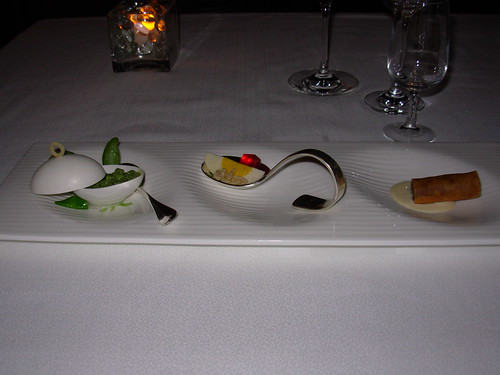
The amusi were three tastes: a barrel of laughs. Least successful was what was labeled the "egg surprise," hopefully not because of the taste. Perched on a sculptural spoon was a wedge of hard-boiled egg, joined with mozzarella, a cube of translucent tomato confit, and crisped rice. While the ingredients seemed eager to please, the amalgam had an off-taste, perhaps from the confit. The idea of the construction bettered the execution. The second entree, a "mushroom cigar" surrounded by a pool of ginger sauce, was a Francophile take on the egg roll. I endorse the two crackly, earthy bites. But the best of the trio - and perhaps the high-point of the meal was a marvelously herbal "haricots verts tartar": a combination of baby green beans and shallots: traditional ingredients with a happy twist. I didn't discover the nature of the dressing, but the dish was simply sublime and sublimely simple. A few classic ingredients, carefully chosen, can reach rapture.

Winter 2007 Photos 218

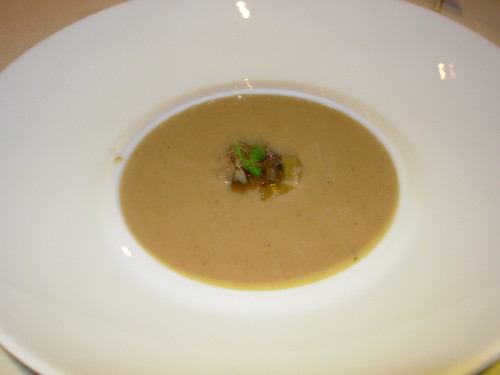
The tasting menu began with a robust Roasted Chestnut and Peanut Soup. This is not the transparent liquor of modernist cuisine, but a real soup with a rich meaty base. The empty bowl was decorated with foie gras dots surrounding a mound of duck confit. The most distinctive taste was smoky pork, although the chestnut and duck notes were clearly evident. There was less evidence of peanuts than I had expected. It was more meaty than nutty. A soup that might have been a tribute to the Virginia goober country bowed to old Paris.

Winter 2007 Photos 220

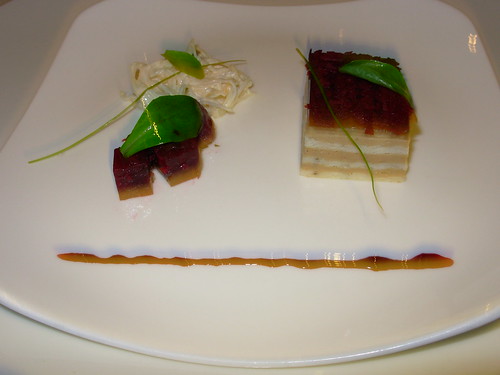
The next dish, as if to mock my Chicago residence, also contained foie gras. This was an elegant Foie Gras-Beet Opera Cake (with a celery root layer) with accompaniments of beet brunois and celery root salad. The dish was more interesting visually than in strictly gustatory terms. The flavors were not sufficiently bright as to make the cake exemplary.

Winter 2007 Photos 221

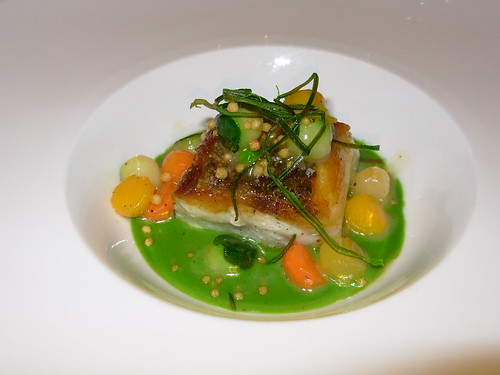
The first seafood dish was the most evocative course of the night: Rockfish with Vegetable Pearls (Rutabaga, Zucchini, and Carrot) and Lemon Verbena Emulsion with Crispy Rice. The perfectly-cooked rockfish benefitted from the verbena emulsion, adding a subtle complexity to the otherwise mild fish, and the rice and pearls added an intriguing, modernist textural contrast. This dish revealed the Chef Richard's debt to classical French cuisine with a light and contemporary sensibility. A triumph.

Winter 2007 Photos 222

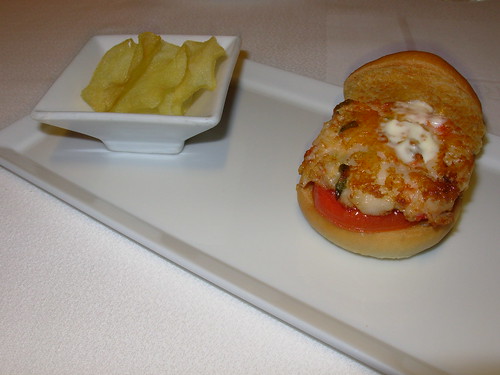
Lobster Burger with homemade potato chips was a conceit. By now such a dish seems routine, and not the most inspired use of a succulent crayfish. This was about all that a lobster burger could be in a fine dining room, but, without sea spray, it never stood a prayer against a perfect Down East lobster roll. A good but wasted course.

Winter 2007 Photos 224

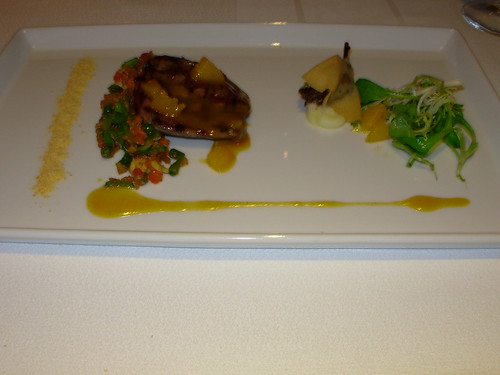
Squab "minute steak" with potato fried rice and citrus-ginger emulsion was another conceit, although more successful in that the comparison with a minute steak was primarily visual. The citrus-ginger sauce - and why not call a sauce a sauce - brought out the slight "gaminess" of the squab without overpowering the quiet poultry taste.

Winter 2007 Photos 225

The cheese course presented four well-selected - and classic - selections: epoisse, blue, rachette, and Camembert, served with pistachio raisin toast.

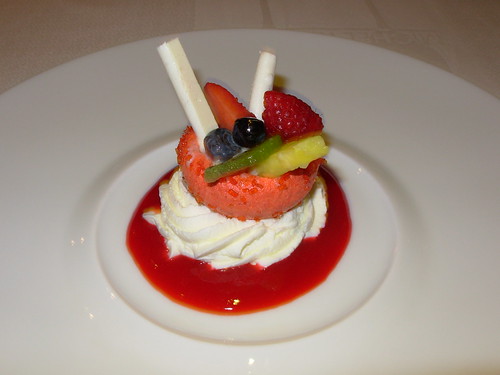
The star dessert followed: Raspberry Vacherin accompanied by raspberry meringue, fresh strawberries and meringue sticks. The photo indicates the craftsmanship of the construction, but the dessert was more than architecture. It was deeply fruity and luscious. This vacherin matched the main courses in its debt to classic cuisine and in its nod to a lightened contemporary taste.

Winter 2007 Photos 227

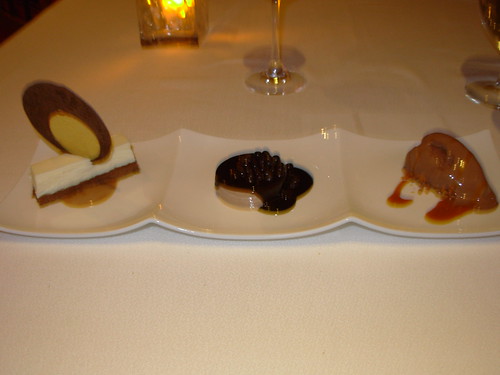
The final course (not including the petit fours) - Chocolate Three Ways - consisted of a rich and smooth chocolate ice cream, an excellent, evocative and buttery coconut macaroon cake with an elegantly swirling chocolate cookie, and a chocolate panna cotta with coffee topping, with jarring, "off" flavors. (Confession: coffee is not my preferred flavor).

Winter 2007 Photos 228

Winter 2007 Photos 229

Chef David Deshaies is the Chef de Cuisine of Michel Richard's Citronelle, and his talent is not to be denied. Of the foremost American restaurants, few now rely on classic culinary inspiration as much as Citronelle. The finest dishes - notably the monkfish and the vacherin - are contemporary inspirations of the classic. And yet this debt tethers Citronelle to the past, rather than opening the door to an amazing cornucopia of the future. Still, Citronelle reminds us that contemporary cuisine stands on the shoulders of giants.

Citronelle
3000 M Street, NW
Washington, DC (Georgetown)
202-625-2150
http://www.citronelledc.com

Friday, March 23, 2007

Chowder Games - May Street Market

Dining recently at May Street Market, the West Town restaurant, recently celebrating its first anniversary, reminded me of how much I treasure restaurants. Not just the temples - the Trotter, Alinea, Le Francais, or even Frontera Grill - but those two-star templettes, that even when they occasionally stumble, provide so much pleasure at a price that permits middling diners a routine fete. And there are no shortage of these restaurants in Chicagoland, where for well under $100, a diner can indulge as a lesser-sybarite. Consider Avec, Crofton, Lula, Prairie Grass, One Sixty Blue, Spring, Magnolia Grill, Rhapsody, West Town Tavern. The list could go on and on (including Italian and Latin-inflected boîtes). These sterling establishments are hardly interchangeable, but each is serious about food and ambiance, while not performing in the four-star circus.

Within this crew is surely Chef/Owner Alexander Cheswick's May Street Market (always confused with the quite distinct nuevo-Latino May Street Café on Cermak). May Street Market sports a clean, spare space. Some find it cool, others simply cold. As a setting for cuisine it has a white box purity (the bar area is more colorful and is more visually striking). May Street is also known for their affordable wine list (they do not have a corkage fee - either select their wines or choose water). We ordered a splendid 2003 Neil Ellis Stellenbosch Cabernet blend for $38 (about twice the asking price for this South African bottle; not an inappropriate markup).

Service was cheerful, although at our corner table, the busboy and waiter found choreography difficult. We also appreciated the cheer of Chantal Randolph, May Street's Managing Partner, now in Chicago from her home in Zaire.

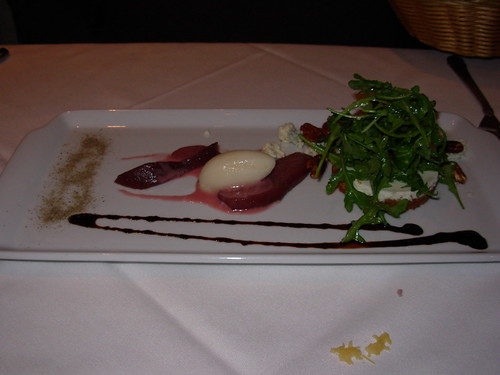
Much of the food was worthy of song, inspirational takes on current trends in cuisine. May Street is known for their Maytag Blue Cheesecake with Red Wine Poached Bosc Pear, Arugula, Spiced Pecans, and Bartlett Pear Sorbet. The savory cheesecake was heavy, and needed to be speared with the poached pear or sorbet. By itself, the cake didn't merit raves, although the plate itself was an elegant mix.

May Street Market Photos 001

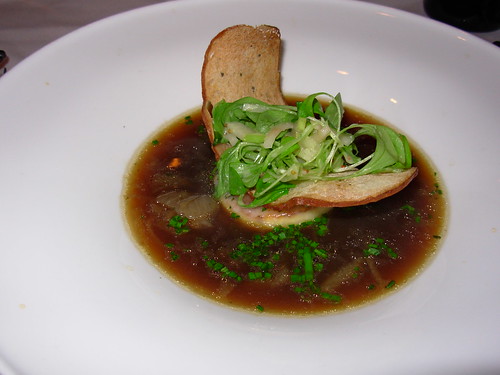
Better - and oh so amusing - was May Street's commentary on molecular cuisine. I thoroughly treasured Cheswick's Deconstructed French Onion Soup with Apple Onion Flan, Mahon Cheese, and a Pretzel Crouton. The soup was sweet and tangy, and lacked the earthy weight that often characterizes Non-deconstructed Soupe l'Oignon. Its cleverness - a twitting of the preposterous outrages of Grant Achatz - in no way marred the favored combination of apple-onion flan, Mahon cheese, and the crouton. Every bite was sublime, including each micro-green. A memorable dish.

May Street Market Photos 002

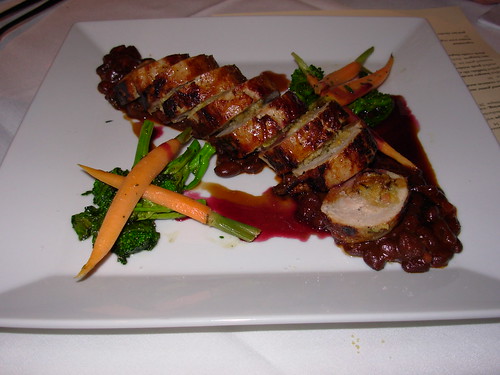
Both main courses were lush and indulgent. Of the two entrees, I give a bare edge to Stuffed Pork Tenderloin with Pancetta and Apricots, served over black beans with mustard grain jus. It was moist, fruity, and dense with pleasure, although, as with all May Street dishes (so common in our dulcet gustatory age), it leaned toward the honeyed.

May Street Market Photos 003

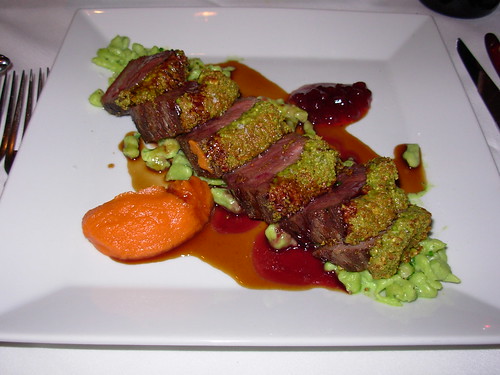
Perfectly Roasted Venison Medallions in a Pistachio Crust with Carrot Purée, Chive Spaetzle, and Lingonberry Sauce was another sterling dish of joyously juicy deer. Still, Chef Cheswick might be reminded that we have four tastes, not merely sweetbuds. This is a cook who offers no bitter love to his diners. The pistachio crust was an instance in which less would have been more. In contrast, the chive spaetzel, appearing as lime-green lima beans, was a delicate surprise. However, the best spot was a perfection of carrot purée. Was there another vegetable for which the word ethereal would have better fit? I suspect not.

May Street Market Photos 004

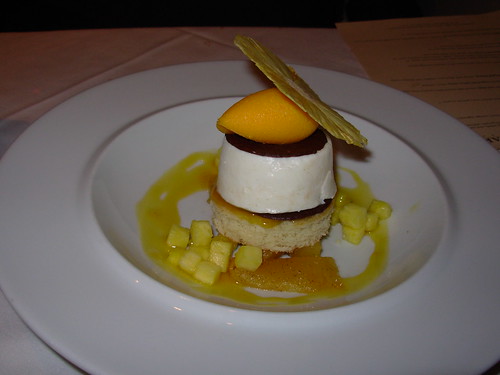
For dessert we shared Coconut Panna Cotta with Vanilla Poached Pineapple, Mango Sorbet, and a Coconut-Coriander Cake. After the splendor of the meats, this dessert faltered. Each element lacked a strong flavor. The cake, absent a powerful memory of coconut or coriander, was dry and plain. The dish appeared lovely, but the love ended at the cornea. The dessert menu reads well, but we lost the gustatory lottery this night.

May Street Market Photos 005

Although May Street Market claims to focus on "regional producers" (and sustainable farming practices), a menu that lists apricot, ginger, pineapple, coconut, mango, lingonberries, sea scallops, truffles, gulf shrimp, calamari, Spanish goat cheese, lemon grass, buffalo, and Dungeness crab has an oddly expansive understanding of region. If we eat global, why not think global? Yes, Maytag Blue Cheese is produced by our friends in Eye-o-Way, but for this early spring menu, a claim that ennobles the local seems a conceit.

Still, May Street Market is a welcome and smart addition to the Chicago dining scene. Perhaps it lacks a distinctive niche, but this takes nothing from its culinary charms. As far as I am concerned, Chef Cheswick can deconstruct my chowder any time he wishes.

May Street Market
1132 West Grand
Chicago (West Town)
312-421-5547
http://www.maystreetmarket.com

Saturday, December 30, 2006

What's Not to Like? Chicago Carlos' Restaurant

The 2006/7 Zagat's Guide to Chicago Restaurants - bless its tiny democratic heart - awards Carlos, Carlos and Debbie Nieto's contemporary French place near Highwood's restaurant row, a ‘29,' the highest accolade in all of Chicagoland. Is Carlos Chicago's best? Perhaps not, but unlike our T&As - Trotter's, Tru, Topolobampo, Alinea, Ambria, and Arun's - Carlos finds few detractors on Nina and Tim's three-point rating scale.

Despite this uncertain accolade, Carlos may receive less attention than any other serious culinary location. It is not that the cuisine at Carlos - or its chef - are old-fashioned. Granted this is not molecular cuisine, but it certainly is aware of and indebted to contemporary trends. And Carlos more than borrows. The menu is as creative as the most impressive contemporary fare in the region. Perhaps Carlos suffers from its location on the border of Highland Park (although Vie, Le Titi, and Tallgrass, much less Le Francais, do just fine), or perhaps from the sense that it a proprietor-driven restaurant (Carlos Nieto receives the press), rather than a chef-driven one. Can you name the chef at Carlos? It is Ramiro Velasquez, and he can hold his own within anyone in this diner's town. Still, one of my most pleasurable meals in the last few years was a Valentine's Day dinner at Carlos, and my wife and I determined to return before New Year's.

Carlos is not an establishment that trades on its frightening pretensions. Indeed, one might consider the smiling, congenial staff to be too playful, lacking in gustatory gravitas. Unlike restaurants that are so filled with themselves that they provide a genealogy of each ingredient, most dishes at Carlos are served without explanation. The cheerful, competent staff is largely Hispanic, but I found no Iberian bows in the dishes. Borrowing from older culinary traditions, servers dramatically whip away the silvered covers of serving dishes, surprising diners with the pleasures underneath. The wood paneled room is comfortably understated, not an architectural gasp, but warm and inviting.

Because Carlos looks into Chicago from its perch in Lake County, our amuse was a tiny ramekin of foie gras, quail egg, radicchio, finely chopped vegetables, and the inevitable microgreens - a finger in Richie Daley's eye. Put aside the politics, the dish was an awakening. The compilation was complex without being overwhelming, and the flavors, smooth and creamy, just short of bold, were well-modulated. This was an amuse in which the chef was explaining his authority, both in his choice of ingredients and in his confidence in his craft.

We both selected the Degustation Menu, a seven course parade, with a pair of choices for the larger appetizer and the entree. In addition, Carlos invites diners to select choices from the a la carte menu. An inexplicable quirk is that some changes carry a heavy upcharge, while others do not. One can order Chilean sea bass without additional charge. However, if you choose John Dory, you pay $15.00! Both dishes are priced at $39.50. Go figure.

We began with a lovely "Parsnip Bisque with Roasted Chestnut Mousse and Valrhona Les Perles Craquantres" (petite Cocoa Puffs). The presentation was an artistic dream, and the soup as bracing as a warming hickory fire. Chef Velasquez laid down a marker; he has a contemporary sensibility. The bisque was a brilliant launch. It is not Velasquez's style to overpower, but those bits of Valrhona confirmed that this was no homey, safe cuisine. I have only eaten at Carlos in winter; I was itching to learn of their summer cuisine.

Carlos Photos 004

"Mountain Huckleberry Glazed Squab Breast with Grilled Pears, Shaved Fennel and a Cabernet-Wild Mushroom Reduction" was another impressive composition. Perhaps it borrowed too heavily from culinary cliques (the requisite fruity-duck), but if one doesn't think too hard of gustatory history, the dish was so amiable that it was hard to reject. The fennel added a more refined taste that nicely matched the mushroom reduction.

Carlos Photos 005

"Winter Carnaroli Risotto with Kabocha Squash, Spaghetti Squash and Chestnut Puree" completed our trio of appetizers. I cannot differentiate Arborio from Carnaroli, but the mix of ingredients was another toast to winter, and the chestnut was a melodious refrain of the soup. Risotto needs to be properly portioned so as not to dominate the meal, but to be more than a tasting, and the small timbale of grain and squash was filling without weighing heavily. Provocatively demonstrating Chef Velasquez's brave facility, a flash fried, feathery basil leaf stabbed the mold. Breathless.

Carlos Photos 008

Passion Fruit-Mandarin sorbet surprised by its refusal to sooth the sweet-tooth. As a good palate cleanser must, it awakened my mouth in its firm and unyielding tartness. The mandarin was a puckery and mighty taste.

We split entrees. I selected - from the a la carte menu – "‘Roulade' of Muscovy Duck Breast with Veal Sweetbreads, Baby Shiitake, Duck Confit Stuffed Baby Bok Choy, and a Vanilla-Seven Spice Reduction." This ‘roulade' was striking in its presentation, and complex in its flavor. I was less taken by the flavor and texture of the stuffed bok choy, but it was an interesting conceit. The duck and sweetbreads made for a startling pairing, and the vanilla reduction was impressively aromatic.

Carlos Photos 010

Better yet was my wife's choice, "Pumpernickel Crusted Barramundi (Australian giant perch) with Pumpkin-Lobster Reduction and Diver Sea Scallop Stuffed Mussels with a Sage Beurre Noisette." Let me be succinct: the barramundi with its napping of pumpkin-lobster was one of the most tremendous dishes of the year, a combination of tastes that I will not soon forget. It was brilliant. The scallop stuffed mussels was another of the chef's conceits, but a very tasty one. But that barramundi with its supremely opulent lobster reduction married to the compliant pumpkin's slightly bulky sweetness! Wow!

Carlos Photos 011

And now, sated, perhaps we were secretly transported to some eatery down the street. Never have I eaten so well under the hands of the chef and been so dismayed when handed off to the dessert crew. When I asked our server of the pastry chef, not listed on the Carlos website, he responded "Elizabeth." Could she be in the witness protection program? Let me not be too harsh. Perhaps we are in the hands of a novice or a gifted cuisinaire on a bad hair day. In truth, the desserts were neither more or less distinguished than dozens of suburban establishments.

We begun with a "surprise dessert." When my wife tasted her profiterole, she muttered that it was stale (or stale-ish). Could this have been the surprise? She might have mentioned that the vanilla ice cream was both over-frozen and under-flavored. She could have noted that the chocolate sauce seemed wan, thin, and ordinary. Aside from an odd pair at Le Bernardin, never had I had two dishes in sequence that traveled so far from zenith to nadir.

Carlos Photos 013

The sympathy of desserts were only better in comparison. None of the trio were distinguished. The almond tuile with orange ice cream was characterized by more overly frozen custard with a somewhat bitter off-taste. The small cube of pumpkin-chocolate layer cake was less distinguished that cakes found at the better bakeries. The tiny ramekin of Vanilla Creme Brulee was smooth and sweet underneath an overly firm crackly crust. The concluding the petits fours were serviceable, but did nothing to save a disappointing end.

Carlos Photos 014

We are in the midst of the age of sweets. Here in Chicago (think Mindy Segal) and in New York (think Will Goldfarb) dessertistas are laying down markers. I'll assume that our evening was an off-night, but, if not, a restaurant that is as wise, as happy, as creative as Carlos should wise for us to gasp at the end, not to yawn. A chef as gifted as Velasquez deserves a Goya or Picasso at his side. If not, at least we could have been presented with a lagniappe of candied foie gras for the trek to Rogers Park.

Carlos
429 Temple
Highland Park, IL
847-432-0770
www.carlos-restaurant.com

Saturday, November 25, 2006

Schwa de Vivre - Chicago - Schwa

10:01 Wednesday morning found me punching numbers into my cell phone, cadging a new reservation at Schwa, Chicago chef Michael Carlson's hot and intimate storefront amazement. Less than twelve hours earlier I had been finishing dessert under Carlson's command. I had been away last year when Schwa opened to squeals of delight and unaccented schwa-y sighs.

Carlson is a graduate of the Grant Achatz school of dining as aristocratic amazement and has worked with Hester Blumenthal at England's noble Fat Duck, but Schwa has a different vision. Cooks fantasize opening a small boîte for the pleasure of a small circle of friends. And some few do. Michael Carlson is one. Schwa is a 28-seat restaurant in what some high-toned folk have labeled a "dodgy" stretch of Western Avenue (an ungentrified area of Chicago's West Town). The restaurant is situated in a pleasant-enough storefront, although sniffers might deduct points for decoration as some did for the late lamented Matsumoto (and seated by the radiator, my hot flashes were not only from the passion of the kitchen). Music piped courtesy of local white rappers, the melodic preference of the staff. Schwa's soundtrack is many leagues from Le Cirque.

The staff consists of three cooks, a helper, and a server, although everyone, including Chef Carlson (and Sous Chef Nathan Klingbail), carried plates. With two set degustations (including the eleven course menu I selected), the staff had a firm idea of their evening tasks. With the price of the full menu at $100/person (comparable to Moto or Daniel Humm's Eleven Madison Park in New York), savings from their modest rent is not passed on. Schwa is not a restaurant that is unaware or ashamed of its skills. (Schwa doesn't have a wine list, and the corkage fee is a wildly, trippingly modest $5.00/table).

Carlson's cuisine owes much to Achatz and other culinary modernists, although Schwa not as showy as Alinea or as antic as WD-50. I was struck by Carlson's use of negative space. As with minimalism in art, the emptiness directs attention. If the food was molecular, some plates could have used a microscope (OK, a magnifying glass). The pictures tell the tale. When I arrived home after my eleven-course banquet, I prepared a snack.

Let my phone call serve as evidence of my esteem. Michael Carlson among the most compelling and original chefs cooking today, an artist to watch. The opening of Schwa is a significant culinary event, dividing the decorator from the cook. As one who has groused at the "Disappearing Chef Syndrome," it is comforting to see Chef Carlson laboring at his stove. This is a chef who unlike some Iron Chefs doesn't need a map to find his restaurant. Should you find a hair in the soup, test for Carlson's DNA. Had not Alinea opened in 2005, Schwa is a dream personally sauteed and souffled.

Still, the critic's code of ethics prevents me from claiming that my meal was the brightest of the year (I ate at Per Se three times; Schwa was an improvement over one of those meals). Some dishes were sublime, splendid, and spectacular, some soared, and a few were good. Throughout the meal, a diner realized that there are some luxe touches that only a capacious staff can provide. Schwa's perfection was in the combination of astonishing food in its tight sphere - the diner's faith in the craftsman's touch.

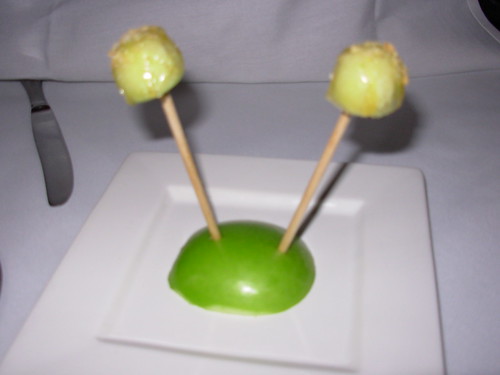
Chef Carlson saved the worst for first. The amuse was two small candied apple balls, sprinkled with fleur de sel. The salt was startling, but the apple was more Coney Island than Midtown. Modest, but not deceptively so. I began to muse about hype.
Schwa Photos 001

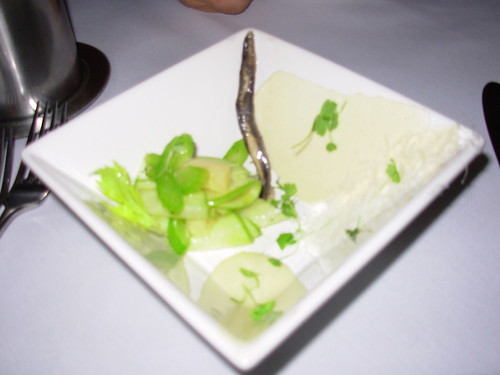
Happily the salad course set things right. Chef Carlson composed an engaging salad with white anchovy, apples, celery, celery root, and Manchego cheese. With its bold flavors, subtle colors, and unassuming ingredients, it could have been an homage to Charlie Trotter. It was a dish that owed more to the new American cuisine that Trotter has been linked to than to the revolutionary fervor of molecular dishes. The salad was a blissful, bright introduction to Schwa's range.
Schwa Photos 002

For soup, we were treated to a theatrical set-piece, Prosciutto Consomme with Melon and Arugula, a dish perhaps inspired by the vertical cuisine of Alfred Portole at Gotham Bar and Grill. Stacked languidly, as if 2x4s left by a casual carpenter, were two thin shaved slices of ham, one crispy and one smoked and thinly cut. The neighboring cup of bullion proffered the purest essence of ham. The fresh melon and arugula flakes were bit players in this moist and porcine drama.
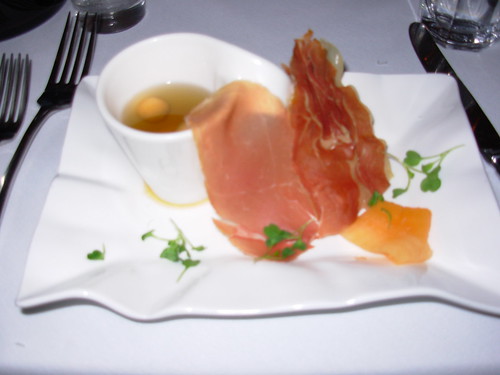
Schwa Photos 003

Carlson's Quail Egg Ravioli is that rare act of inspiration that could qualify a chef for a Genius Award. My companion asked if he could skip the rest of the menu and be served a heaping bowl. The ravioli was served with ricotta, brown butter, parmigiano reggianno, and as much white truffle as Caligula would need for a month of orgies. Here was a dish that channeled Thomas Keller, while knowing how much truffle to perfume the quail egg before a defibrillator was required. Be still my beating heart! Carlson has created the most erotic recipe this side of Tampopo, lush, gooey, musky, preposterous, and very, very opulent.
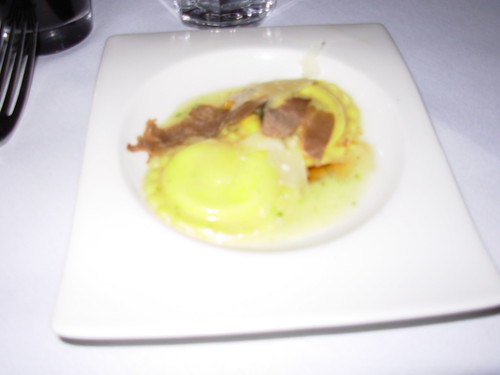
Schwa Photos 004

Looking at "Illinois Sturgeon Caviar with Avocado and Cauliflower," one might imagine another Keller inspiration. It wasn't quite. Serving Illinois Sturgeon Caviar might satirize our desire to eat local at all cost. This was roe that serves in a pinch. The creamy cauliflower was a more joyous match than the avocado.
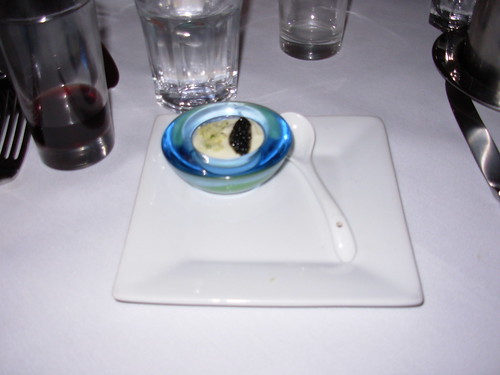
Schwa Photos 005

The butter-poached lobster was a surprise, off-the-menu entry, and it was the first of Carlson's minimalist, molecular dishes. The lobster was served with sauteed gooseberries, potatoes, and Swiss chard napped with a lavender emulsion foam. The lavender brightened the shellfish with its flowery floral overtones. In the past year, I have had some remarkable lobster dishes, and this lobster can be inducted into the club. By placing pieces of the lobster on the rim of the plate, Chef Carlson engaged in frame-breaking, emphasizing how much of the plate was unused and how airy his presentation. This was another glittering combine.
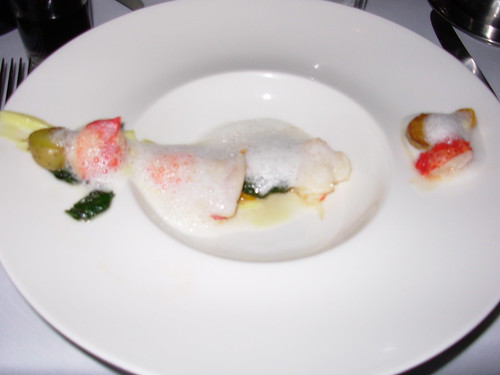
Schwa Photos 006

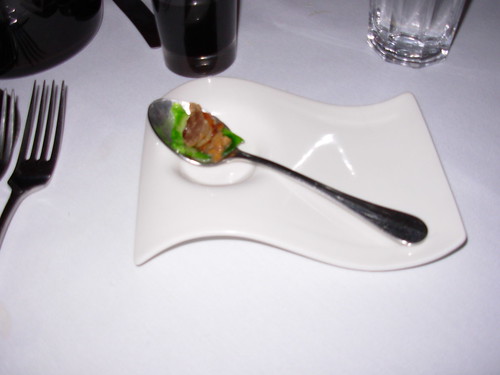
On the printed menu Nantucket Bay Scallops were scheduled to be served with the gooseberries, lavender, and potatoes. Instead we were served scallops with white truffle (again, happily), chanterelles, and Brussel Sprouts. This was a one spoon dish (silverware that owed much to Alinea), but it was a terrifically powerful spoonful. The mushrooms, sprouts, and truffle created a dish that captured the mind of mid-November.
Schwa Photos 007

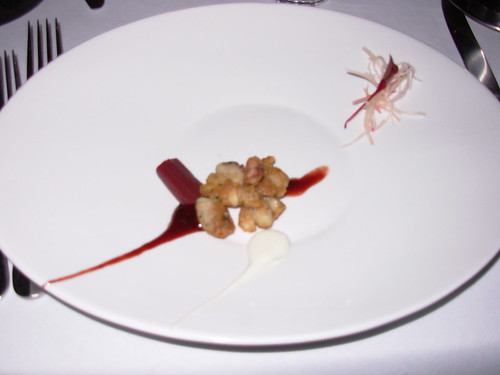
Chef Carlson was surely teasing us with his composition of Sweetbreads, Rhubarb, and Humboldt Fog Cheese. In the middle of a platter was a small pile of thymus, smiling like a goiter. As if emphasizing the embodied origins, a smear of rhubarb red and foggy white flowed from the organ meat. The presentation was characteristic of the Carlson aesthetic, although the dish, tasty in each part, seemed too carefully calibrated, lacking a warm heart.
Schwa Photos 008

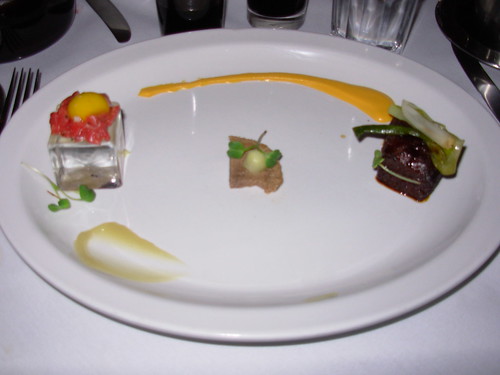
For the main course, we were served "Beef: Raw, Pickled, and Braised." The trio of servings were petite, and their placement on a spacious plate emphasized their bulk - three bites and on to the next course. The raw was tartare with (I believe) quail egg, served on a plastic "ice cube," accompanied by squibs of sesame oil and yuzu. The yuzu was a surprising match. I have bitten my tongue on many occasions, but never had such a pickled bite. Braised short rib was served with a sweet tomatillo puree, and was delicious, if not shockingly so.
Schwa Photos 009

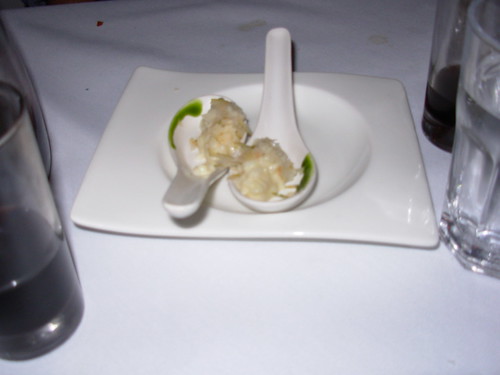
"Cheese" was another heroic single bite. A spoon of al dente risotto, tart apple and Morbier cheese (a semi-soft, ash-filled cow's milk cheese) was suffused with flavors that revealed a gustatory harmony. The apple cut through the creamy and rich rice and cheese. Like other bites, this might have been followed by a train of other bites. Just as the first sip of wine does not perfectly predict one's ultimate pleasure, one-bite tricks produce similar vexation. The first bite alerts the diner what to evaluate, compare, and combine. Dishes need time to breathe and breed.
Schwa Photos 010

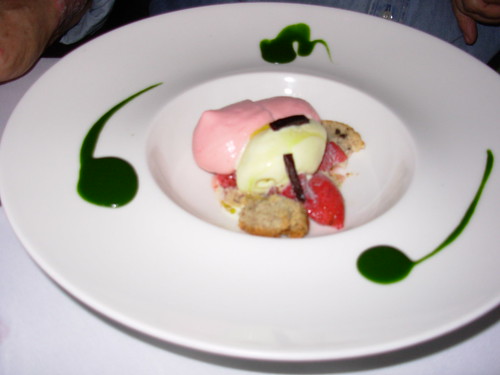
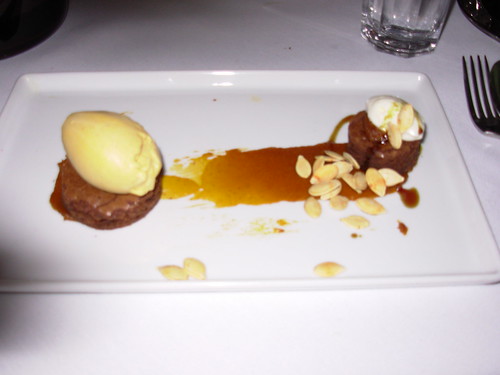
Our two desserts were less compelling that the main courses. I wasn't fond of the olive shortcake with olive oil ice cream and strawberry mousse. It's sweetness had an off-taste. The plate was startlingly pretty, but not divine on the tongue. Chef Carlson's chocolate brownie with pumpkin seeds was a more satisfying construction, but not filled with the possibilities of memory. It was a fine brownie. Were it permitted, I would have selected other confections.
Schwa Photos 011

Schwa Photos 012

Michael Carlson matters for our culinary future. He is blessed and limited in his locale. How much better he can get in his current location, and should we wish that he has a drive for improvement. Some dishes were a little off and some might have been tweaked or expanded, but the idea that we were eating food this stunningly satisfying in a little storefront on the West Side of Chicago made us brave adventurers with Carlson a bravura guide. I admit - sheepishly - that I award the idea of Schwa a solid four stars with its food at three-stars-plus. But that night I was where the action was - and where the action might not be for long. Does Chef Carlson owe us a sumptuous showplace with a corps of cooks readying an elaborate mise-en-place or does a heady gig more than suffice? I'm not taking chances. My morning-after routine is to schedule a future repast.

Schwa
1466 North Ashland
Chicago (West Town)
773-252-1466
www.schwarestaurant.com